UK Gender Pay Gap Awareness: How to broaden the conversation at the workplace

3DSGenderPayGap_Coventry

Chairing an employee awareness session about the UK Gender Pay Gap in Tech at the Dassault Systèmes office in Coventry.

Recently, I was invited to chair a “Breakfast & Learn” session at our Dassault Systèmes office in Coventry (UK). The topic: UK Gender Pay Gap. This article is a reflection on that great learning and interactive experience.

What is “Breakfast & Learn”? One-hour monthly awareness sessions organized by our Great Place to Work (GPTW) ambassadors around a specific theme. Ideally, the presenters should keep the topic light and open, avoid the profusion of slides, encourage the audience participation, and limit the use of jargon. A healthy breakfast is provided along.

Why me? I founded the EuroNorth Dassault Systèmes Lean In circles in 2016 to advance diversity and inclusion initiatives at a regional level, I’m a member of the EuroNorth Diversity and Inclusion Council, and I’ve had the pleasure to host virtual employee meetings with our UK HR team to discuss the findings of our gender pay gap reports for 2016/2017 and for 2017/2018.

Why this topic? I learned that the recent publication of the Dassault Systèmes Gender Pay Gap report had been a hot topic for discussion in this office. There were different views regarding the scope, key indicators, and impact of the UK gender pay gap as well as the usefulness of reporting the data. Continue reading

Two Alpinists in Mount Tech. Take #1: Meritocracy

A woman and a man climb a mountain with the inscription “Mount Tech”. They have reached the same altitude, which is marked by a dotted line pointing to a vertical ruler labeled as “meritometer”. The woman has attached four weights of four different colors. The man has climbed the mountain using four pitons colored in the exact four colors of the woman’s weights. A legend indicates the colors represent bias, society expectations, stereotypes, and salary. At the top, a man thinks “That’s what true meritocracy looks like”.

From the Merriam-Webster Dictionary

Piton  \ ˈpē-ˌtän \ a spike, wedge, or peg that is driven into a rock or ice surface as a support (as for a mountain climber).

Weight \ ˈwāt \ : a heavy object to hold or press something down or to counterbalance.

Meritocracy \ mer-ə-ˈtä-krə-sē \ : A system in which the talented are chosen and moved ahead on the basis of their achievement.

Disability as an Innovation Driver

Yellow light bulb over physical disability symbols with the caption “disability as an innovation driver”

(5 min read)

The typewriter, internet, closed captioning, text-to-speech, eye gaze.

All those inventions have in common a widespread application and impact. They were also originally created to overcome a limitation imposed by a disability. And there are a lot more, as this article points out.

Surprised? I was. Stereotypes do narrow our thinking.

Myth #1: Disability happens to others.

Continue reading

Want to curb climate change? Empower women

I was not planning to like Moment of Lift (source) by Melinda Gates. Although I was tempted to read it, I always bailed out at the last minute because somehow I thought it would be some kind of 101 Wishful Thinking for Women. When the World Economic Forum Book Club (source) chose it as a May read, I thought it may be a signal. It was.

Continue reading

Women & Money | Shame & Guilt

I love the Masters of Scale podcast, hosted by Reid Hoffman, co-founder of LinkedIn and investor at Greylock. What’s not to like about a podcast about innovative business models, that is fun and committed to a 50-50 gender balance for guests?

Typically, each episode starts with one of Reid’s theories about scaling, which then he proceeds to test and tweak with his invitee. The theory explored on the 12th March podcast was

I believe you need a diverse portfolio of viewpoints to see the opportunities others are missing.

Reid Hoffman

His guest was Sallie Krawcheck, CEO & Co-founder of Ellevest, an investment platform aimed at women. Sallie is a fantastic storyteller and her story worth telling. Personal picks:

  • The beginning of her career in Wall Street
  • Being named the “last honest analyst” when the dotcom bubble burst
  • Her vivid depiction of the “bro” investment culture
  • The founding of Ellevest  to fulling her “life’s mission to unleash women’s financial power and get them invested in their biggest goals”
  • Her commitment to drinking her own medicine: searching for a co-founder that was as different from her as possible, and leading a company with two-thirds women, 40% people of color, and a 50:50 female-male engineering team.

All the interview resonated with me but the following

we women have been socialized in a certain way. Money is really viewed by most women as sort of the guy’s thing. One example I’ll put out there is all the shame around money.

When I talk to women, there’s not an amount of money that we as women can earn, any individual woman can earn, that she doesn’t feel ashamed about. Whether she’s earning too much, because her friends aren’t and they’re going to be jealous, or too little because she wishes she was able to do more for her kids – whatever it is, society has really told us: shame, shame. 

So we receive these insidious harmful messages about money. And we had to break through that.

Sallie Krawcheck

That affirmation stayed on my mind and kept coming back days after listening to the episode. Shame simply doesn’t resonate with my “money” experience or that of other women around me. Could I get any insights from Brené Brown, an expert on shame

I define shame as the intensely painful feeling or experience of believing that we are flawed and therefore unworthy of love and belonging – something we’ve experienced, done, or failed to do makes us unworthy of connection.

[…] I believe that guilt is adaptive and helpful – it’s holding something we’ve done or failed to do up against our values and feeling psychological discomfort.

Brené Brown

Armed with this distinction, I interrogated myself about what money means to me. And the following two needs came up loud and clear

  • Independence: As an immigrant – and daughter of immigrants – it has been inculcated in me since a very early age that money, and especially having a reliable income stream, is key to attaining independence and control over my life.
  • Security: Money mitigates bad times: poor health, job redundancy, housing damage, natural disasters.

which in turn elicited a core value: responsibility.  The responsibility of maintaining a regular source of income, not dropping the ball with my savings, supporting my close circle if in need, demonstrating those I love that I care for them… To me, this non-exhaustive laundry list doesn’t look connected to shame, but more connected to guilt. And guilt is pervasive as well (sorry Dr. Brown, but I don’t always find guilt all that “adaptive and helpful”).

Whilst I don’t deny other women’s experience about being socialized associating money with shame, society has instilled into me – and other women I know – that money comes with a pint – or three – of guilt and condescension. And that shows in the language we use.

In the stimulating Medium article In Praise of Pink Covers and Redefining Chick Lit, Sandra Ann Miller highlights the difference in the vocabulary and tone used to refer to women and men non-essential expenditures (e.g. Contemporary Women’s Fiction belittled as “Chick Lit”). Some examples of how society labels such female transgressions with money are

  • Guilty pleasures
  • Weaknesses
  • Spending sprees
  • Indulgences
  • “Me” time

Conversely, I’ve never heard or read about a football season ticket, a poker night, an afternoon binge-watching the rugby Six Nations Championship, or a weekend spent playing video games referred to as “guilty pleasure”. Instead

  • A requirement (I need to…)
  • A desire (I want to…)
  • A sense of entitlement (I deserve to…)

Is this acute sense of financial responsibility only a trait of mine? Actually no. The UN reports that “When women work, they invest 90 percent of their income back into their families, compared with 35 percent for men.” Talk about gender gap!

What if we dare to shift the weight of that responsibility to 50-50? Would the world fall apart if both women and men would invest 62.5% of their income back to their families? What could women achieve if society would support them towards investing that remaining 27.5% of their income in themselves without guilt? Developing the business ideas they believe in (even if they fail!), the art they choose to create and appreciate, and the hedonistic activities they want to pursue?  

I believe “guilt” and the female hyper-financial-responsibility syndrome can be reframed and is curable! My first step: reframing my “guilty pleasures” and “non-essential” obligations in terms of needs/wants/entitlements.

What’s your relationship with money? And does it serve you well?

PS. Sallie – Your rock!


Feminist Tech Career Accelerator

Three things are keeping you from getting the tech career you deserve

Your Brain * Your Education * Patriarchy

Thrive In Your Tech Career With Feminist Guidance

Achieve your career goals * Work smart * Earn more

Click below to learn more about the Feminist Tech Career Accelerator

My first LinkedIn Article: Diversity is key to delivering excellent customer support

BIOVIASupport_5KeyAttributestoOutstandingSupport

In my first LinkedIn article, I share 5 key factors to the success of the customer support team I lead. Predictably, diversity of workforce and perspectives is crucial to delivering exceptional customer service. Continue reading

Purl: For Pixar achieving gender equality at work is the low-status groups’ responsibility

Purl_202yearslater

Purl Final Scene: WARNING Wishful Thinking Ahead!!!

Last week, I received a link to Purl from a fellow diversity and inclusion advocate with the line “Wondered if you had seen this… it’s a brilliant explanation of the male-dominated workplace”.

Upon clicking on it, I was redirected to a Pixar 8-min short animation film called Purl Continue reading

When a Toilet Becomes a Symbol of Exclusion

Photo of a sign with an arrow pointing to the right followed by a transgender symbol at the center and disabled toilet sign.

A toilet sign at the TEDxWomenLondon2018

Toilet /ˈtɔɪlət/

A structure like a seat over a hole where you get rid of waste from your body.

A room in a house or public building that contains a toilet.

Early this month I attended LondonWomen. As per the director and curator of the event – Maryam Pasha – it was 8 years in the making. The stimulating array of speakers showed a labor of love, commitment, and resilience. 

I went to the event to keep up with the state-of-the-art in women’s issues and to network. I did a lot of the first (more at the end of this post), less of the second.

I also had a “toilet” epiphany: Continue reading

25th November – International Day for the Elimination of Violence against Women

ViolenceAgainstWomenUN

Some resources to understand the massive scale of the problem worldwide:

Continue reading

Headwinds and tailwinds: A framework to build empathy

Cartoon of two cyclists going in opposite directions. Over one of them, there is a smiley sun, whereas there is a cloud blowing air in the direction the other cyclist is going.

Remember last time you were faced with strong winds against you whilst cycling or walking? Probably yes. And tailwinds, i.e. winds that helped you to progress faster? Probably not.

In their scientific article The headwinds/tailwinds asymmetry: An availability bias in assessments of barriers and blessings, Shai Davidai and Thomas Gilovich used headwinds and tailwinds as a metaphor to explain our perception of advantages and disadvantages that we face. Continue reading

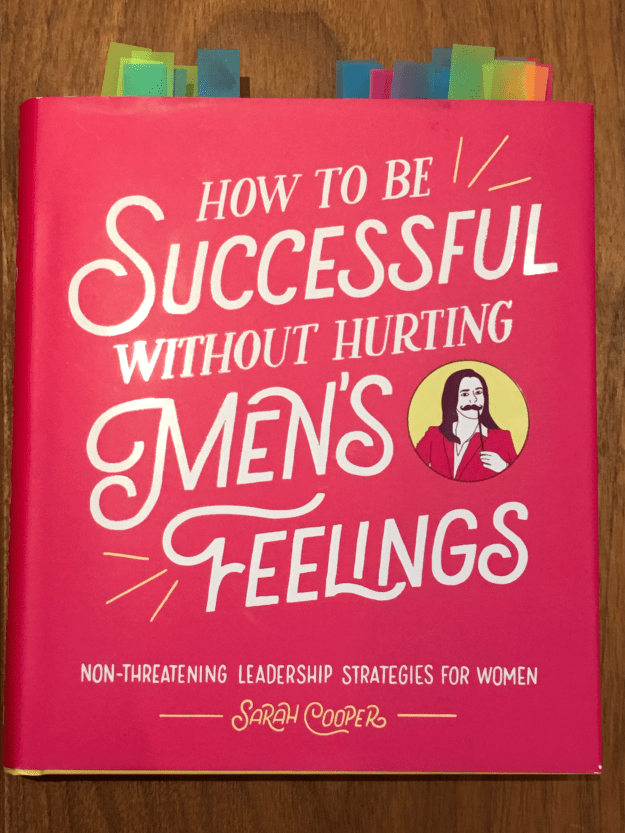
How to Be Successful Without Hurting Men’s Feelings

HowToBeSuccessfull_SarahCooper

Last weekend I finished Sarah Cooper‘s third book “How to Be Successful Without Hurting Men’s Feelings“, out on October 30th. Given that I thoroughly enjoyed the previous one, “100 Tricks to Appear Smart in Meetings“, and my interest in female leadership, purchasing her new book was a no-brainer. Sarah is a writer, comedian, Continue reading

Salary transparency or how to eradicate the gender pay gap

Tech companies such as Buffer and Verve had implemented transparent salary. A realistic strategy to end with the Gender Pay Gap #genderpaygap #womenintech

Two weeks ago I attended the Ada’s List Conference 2018. The Ada’s List is an email-based community of more than 6,000 subscribers (me among them) “for women (and those who identify as) who are committed to changing the tech industry”.

The Conference was structured as a blend of presentations and concurrent workshops covering a vast array of topics related to women in tech. Inclusive design (‘Leaving No One Behind: Building Apps for The Next Billion Users’ by Aygul Zagidullina), new technologies (‘How can we use advanced imaging technology to build a better food system?’ by Abi Ramanan), self-care (‘Discover your self-care non-negotiables” by Babs Ofori-Acquah), and UX (‘Personalising the user experience and the playlist consumption on Spotify‘ by Mounia Lalmas-Roelleke) are some examples.

If there was a talk that both challenged my preconceptions and fuelled my optimism that a diverse and inclusive workplace is achievable was that of Åsa Nyström, Director of Customer Advocacy at Buffer, a company included among the Inc. 5000 Best Workplaces 2018. Nyström discussed Buffer’s value of “Default to Transparency”; more precisely, their policy of transparent salaries. This means that they share via their website all their employees’ salaries as well as the formula used to calculate them. You can even calculate what you would earn working at Buffer here!

Why is Buffer so keen on salary transparency? Because it promotes trust, which in turn is correlated with economic growth. And they can prove it! A study on the impact of trust in organizations based on a nationally representative sample of 1,095 working adults in the U.S in 2016 showcased that

compared with people at low-trust companies, people at high-trust companies report: 74% less stress, 106% more energy at work, 50% higher productivity, 13% fewer sick days, 76% more engagement, 29% more satisfaction with their lives, 40% less burnout.

Nyström pointed out that whilst disclosing salaries has great advantages  – attracting great people and motivating employees – there are some challenges as well. Among them, she pointed out to scalability – ensuring the salary matrix remains consistent as your workforce grows – and becoming publicly accountable. For example, she shared how they were challenged by a customer for paying their marketing team less than the Product and R&D teams.

Buffer_DohertyTweet1

The paradox is that salary transparency is not an alien idea after all. All publicly traded companies in the U.S. must disclose the compensation paid to  CEOs, CFOs, and certain other high-ranking executive officers. However, the salary disclosures don’t permeate through all levels. Even more, most companies have a non-disclosure policy regarding salaries.

Interestingly, recently published research indicates that when employees know their direct manager’s salary – and it is substantially higher to theirs – it increases their productivity and commitment. The authors hypothesize that learning that their manager’s salary is notably higher boosts employees’ motivation as they can see themselves filling their shoes in a few years time. On the flip side, knowing that your peers receive a higher salary has the opposite effect: decreases effort, output, and retention. This would suggest that salary transparency is not enough; it needs to be supported by a “transparent” salary formula linked to market conditions, company budgets, individual employees’ performance, and turnover risk.

The reality is that most of us ignore how our salaries compare to the market and, as the graphic below suggests, this rarely leads to bliss

WhatWeBelieveAboutPay
Most People Have No Idea Whether They’re Paid Fairly

My take is that salary transparency is a powerful approach to making unjustified pay gaps – such as those linked to gender or race bias – disappear. Will you work for a company offering you a salary obviously smaller than that of somebody less experienced and with fewer responsibilities? As a customer, would you purchase services and products that pay Jane Doe less than Bill Smith without a clear justification? Finally, adopting a salary transparency policy also provides very clear pointers regarding what kind of skills and experience are most valued in a company and in the industry, paving the road for those employees that want to progress in the career ladder.

Unconvinced still? Read here about Verve’s successful transition to pay transparency. Verve is a U.K.-based tech firm that maintains an impressive almost 50% female workforce.

Will you be happy to disclose your salary publicly? Do you think pay transparency has more pros or more cons?


Feminist Tech Career Accelerator

Three things are keeping you from getting the tech career you deserve

Your Brain * Your Education * Patriarchy

Thrive In Your Tech Career With Feminist Guidance

Achieve your career goals * Work smart * Earn more

Click below to learn more about the Feminist Tech Career Accelerator

If Men Could Menstruate…

In 2015, the UK branch of WaterAid – an international non-profit organization with the mission of providing clean water, decent toilets, and good hygiene to people that don’t have them yet  –  launched the campaign If Men Had Periods to denounce that more than 1 billion women around the world lack of water and toilets during their menstruation. Furthermore, WaterAid wanted to increase the number of signatories to their Make it Happen petition, which called on world leaders to make sure that the UN sustainable development goals included a target on safe water and sanitation.

Their tongue in cheek approach was successful. Their adds won several awards, their Continue reading

Women, Tech & Systems Maps: My alternative to the magic bullet

Woman of Asian ethnicity with a worldmap in the background. The countries in the worldmap are creeated using 0 and 1.

Women, Tech & Power (Figure adapted by Patricia Gestoso from Pixabay images).

As a woman joining the university in the late ’80s to pursue an engineering degree, I took for granted that gender parity in the workplace was around the corner. The few female professors in our science and engineering faculties reassured us that we were on a good track. They shared how as students they were only 2-3 women per chemical engineering cohort, whilst we could be counted by tens! The message was clear: “”Don’t complain and work hard. Women’s presence is scaling exponentially”.

It’s 2018 and the World Economic Forum reports that the workplace gender gap will not be closed for 217 years. This disappointing realization has sprung a flurry of expert Continue reading

Are you biased? Flip it to test it!

Unconscious bias can be defined as

a bias that happens automatically, outside of our control and is triggered by our brain making quick judgments and assessments of people and situations, influenced by our background, cultural environment, and personal experiences.

Whilst all human beings have unconscious biases, that’s not an excuse for inaction. Unconscious bias impacts Continue reading

Dear Ijeawele, or a Feminist Manifesto in Fifteen Suggestions

Dear Ijeawele


Recently, I listened to the book “Dear Ijeawele, or a Feminist Manifesto in Fifteen Suggestions” by Chimamanda Ngozi Adichie. The audible recording is 1 hour and I absolutely recommend it.

The premise of the book is the following: Years ago, the author was asked by a friend for advice on raising her baby girl as a feminist. Dear Ijeawele is Adichie’s advice to her.

My five favorite suggestions:

Continue reading

Gender equality lessons from a 12-year-old girl

Sexist Comment

Geauga County Maple Leaf, Thursday, July 19th, 2018 Vol. 25 No. 29, p. 7

Julianne Speyer is a 12-year-old American girl that can teach us a couple of things about equality,  fairness, and standing up for what we believe.

Continue reading

Women & Silence

Women and Public Speaking

Recently, I read the through-provoking Women & Power A manifesto, written by Prof. Mary Beard. In the chapter The Public Voice of Women, she highlights that in the Western tradition for the last 3,000 years women’s public speech has been confined to two areas:  (a) the support of their group interests (e.g. women rights), and (b) their victimhood (e.g. Christian martyrs). Attempts to breach that rule are Continue reading

An unconventional ride through privilege

The Collins Dictionary defines privilege as “a special right or advantage that only one person or group has”. The paradox is that is not uncommon that those same persons or groups are oblivious to their privilege in the first place!

Discussing privilege takes us to uncomfortable places. As this article says, “nobody likes Continue reading

How to say “No” to Office Housework

Office Housework

Are you always stuck with taking the minutes at the team meetings? Do all the people in the room expect you to order the catering? You are not alone.

Research shows that co-workers assume that women, and especially non-white women, are expected to do office housework, i.e. pick up all those administrative tasks Continue reading

Stop fixing women

This 1-min video sends a strong message about what needs to be fixed to get more women in leadership.

Ask Google: Is my son gifted? Is my daughter overweight?

SonGifted_DaughterOverweightSeth Stephens-Davidowitz’s book “Everybody lies” assembles his work on what he calls “Google Digital Truth Serum”, people’s internet searches. Seth theorizes that people are more honest when they ask Google than to any other source, including Facebook, which he calls “Digital Brag to My Friends How Good is My Life Serum”.

In this article, the author argues that Google searches suggest that modern American Continue reading

Feedback has gender

Feedback_gender
As women advancement in the career ladder has stalled, there is an urgency to signal “the” culprit: women don’t ask for promotions, women don’t have an appetite for leadership, women don’t sit at the table… Unfortunately, rarely those assertions come with metrics.

A refreshing change is this HBR article summarizing a study based on 81,000 peer Continue reading

What’s normal?

In this 2-min video, Derek Sivers challenges our concept of “normal” and “weird”.

Should Alexa join #MeToo?

Recently, I came across an article in the Engineering and Technology magazine that made me realize up to what extent artificial intelligence (AI) is mirroring our gender biases, conscious or unconscious. Think about the ubiquitous female voice in our home-assistants: Google Home, Microsoft’s Cortana, Amazon’s Alexa, and Apple’s Siri perpetuate the stereotype of female obedience.

What was even more disturbing was to learn that this submissive attitude goes beyond the Continue reading

If there’s one thing men can do to improve women’s life at work, it would be…

In this thought-provoking interview, Ai-jen Poo, a labor organizer and executive director for the National Domestic Workers Alliance, tells men that if there’s one thing they can do to improve women’s life at work, it would be…

Continue reading

The Pink Tax

ThePinkTax

It’s been some years now since I realized that I was consistently paying more than my partner for items ranging from toiletries to fitness weights.

It’s not my imagination – it’s called the pink tax! The Fawcett Society in the UK estimated that “women are paying on average 31% more for an own brand basket of comparable toiletries and are paying 12% more for a basket of own brand clothing items”.

Continue reading

Rosie: Undermining Language Detector

Rosie

Using words like just or actually, apologizing when unnecessary, or using phrases like Does that make sense? or I’m no expert, can undermine your credibility in interviews, negotiations, and meetings.

Continue reading

Color blind vs color brave

In this TED talk, Mellody Hobson – president of Ariel Investments, a US management firm – challenges us to learn to be comfortable talking about uncomfortable topics such as race and gender as the only way to make meaningful change in our workplace and boardrooms.

Are you color blind or color brave?

Copyright © 2018 Patricia Gestoso – All Rights Reserved

Empathy prompts – Walking a mile in somebody else’s shoes…

Screenshot from comparing a text parragraph in English before and after using the Dyslexia simulator bookmarklet. After using the bookmarklet, the letters in the text have been moved around, making it difficult to recognize the orignal text.

Our privileges (gender, ethnicity, religion, socio-economic) make us blind to the disadvantages of others. Additionally, we generalize other people’s experiences based on our preferences, environment, and upbringing. As most of this behavior is unconscious, how can we free ourselves from those constraints and develop more inclusive products?

Continue reading