Tag Archives: #LifeCoaching

How to Reclaim Your Voice After Female Shaming

Image of a woman's head with a woman's hand covering her mouth, whereas the other woman's hand is pressing her forehead to keep her still.
Photo by Sherise Van Dyk on Unsplash

Recently, I delivered a free masterclass on a negotiation framework that has helped hundreds of women, including me. I targeted women in tech as I know from my own experience how often we miss out on salaries and promotions because we don’t have the tools to negotiate or the confidence to do it.

If I go by their first name, all attendees were women. All was going reasonably well, with positive engagement from attendees in the chat, when, in reply to one of my questions about negotiation, a woman in the audience wrote that my repeated use of a specific word during the session made it unbearable to listen to.

I was so surprised that I asked for details, to which the woman articulated how bad it was, and I’d realise it once I get the recording. I thanked her for the feedback, and I continued with the masterclass.

However, that had a negative impact on the audience’s comments, which stopped for a long while. To my surprise, at the end of the session, somebody said that they knew the person and that, paradoxically, she was part of their women in tech group at work.

When the session ended, I was surprised by how hurt I was. As a director of support with over 20 years of experience delivering services to customers worldwide, I’ve been insulted, shouted at, and interrupted during webinars, training sessions, and meetings.

Why did this feel so bad?

Brains like to find explanations for everything, so it went into the rabbit hole of “What she could have done differently?”

  • Dropped from the session
  • Send a direct chat with her comment
  • Emailed me her feedback

What I could have done differently?

  • Queried her about her reasons for delivering that kind of feedback in that form
  • Rebuked her comment
  • Removed her from the session

And of course, I tried to figure out the causes of her behaviour and my reaction… I’ll spare the details and get to the aha! moment of that internal monologue, “What if that had been a man?”

Based on previous experiences with male bullies, I predict that he would have discredited me or the methodology, e.g. “You don’t have a clue about what you’re talking about,” “This framework is useless.” And I also predict that the female audience would have been supportive, e.g. “Nobody forces you to be here,” “It’s helpful to me.”

But this female bully didn’t attack the method or my credibility. She wanted to shame me. That is, highlight in front of everybody what she saw as a shortcoming in the delivery of an otherwise apparently valuable information.

Another important aspect is that unlike in the case of a male bully, there was no support from the other women. Moreover, the person who had invited the female bully felt the need to apologise to me about inviting her…

Reading the fantastic article, I Am Bone Tired Of People Telling Women How to Show Up by Linda Caroll, helped me recognise that this was no fluke: Women know “shame” is an excellent tool against other women.

  • It doesn’t involve physical abuse
  • It’s unrequested
  • It inflicts long-term harm hidden under apparently well-meaning feedback
  • It reinforces the “moral superiority” of the perpetrator
  • It silences the victims’ allies due to the veiled threat that they, too, can become a target

More importantly, the aspect that I find most fascinating about shame is its sadistic nature; the primary benefit for the perpetrator is to know the victim will suffer.

How women use shame

Fortunately for the patriarchy, women are excellent at fostering doubt about other women’s capabilities, and behaviours to harm them.

For example, the manuscript casebooks kept by the medical practitioner, and astrologer Richard Napier (1559−1634), who listened to reports of suspected bewitchment in at least 1,714 consultations in Jacobean England, mentioned that the majority of both accusers and suspects were women: Of the 802 accusers in Napier’s records, 500 were female and 232 were male. Among the 960 suspects identified by this group of accusers, 855 were female and 105 were male.

Whilst shame may not aim to kill its target, it can still be very powerful. The premise involves combining a stated norm with how the victim breaks it.

Examples are sentences like;

  • “You look more rounded. You had such a great body.”
  • “You’re too thin. You looked better when you had some more weight on.”
  • “You look tired. Botox is great.”
  • “If you love your children, you should breastfeed.”
  • “If you care for your children, you shouldn’t breastfeed them after they are 6 months.”
  • “Smart women like you shouldn’t be stay-at-home mums.”
  • (To a female executive) Women shouldn’t prioritise their careers.”
  • “It’s great you share your achievements, but it makes you sound too ambitious.”

Shaming as a weapon is most effective when;

  • It aims to increase the credibility of the perpetrator whilst diminishing that of the victim.
  • The victim cannot articulate a response off the cuff.
  • It’s delivered in public.

But it doesn’t need to be this way.

Pink painkiller pills.
Image by Petr from Pixabay

The remedy

How can we women avoid using shame against other women and in doing so becoming a tool of patriarchy?

As a Victim

Depending on the context, you can,

  • Ignore it — Continue the conversation as if the comment hadn’t been voiced.
  • Name the effect on you — You can reply with “What you said hurt me,” “You’re shaming me,” or “Your comment was disrespectful/humiliating/intimidating/intrusive.”
  • Uncover the perpetrator’s purpose — Ask questions to expose the perpetrator, e.g. “Did you want to shame me with that comment?“, “What’s that supposed to be positive feedback?“, or “What did you choose to share that in public?”

As a Bystander

We’re not absolved from taking action when we’re in the presence of shaming. Again, depending on the stakes, you may,

  • Support the victim — You can ignore the comment and pivot the conversation to another topic, giving the victim the time to recover. You can also offer a positive counterview, e.g. “I love how you presented”, “I admire women who look confident in their abilities.”
  • Challenge the perpetrator — You can offer a different perspective, e.g. “There aren’t norms for how much women should weigh” or “What’s the evidence that breastfeeding children for longer than 6 months is harmful?
  • And of course, you may shame them back, e.g. “Women should support other women, not attack them”, “Your feedback is not useful”, or “You’re behaving like a bully.”

As a perpetrator

By now, you may think that you’re on the “right side” of the story. Unfortunately, most probably aren’t, like me. How can we ensure we are not shaming other women gratuitously when delivering our opinion?

We must interrogate our purpose and the outcome of our opinion before, during, and after our comments.

Before

  • What’s the purpose of my comment to help the other woman?
  • Do you have evidence that this woman doesn’t already know what you’re going to tell them?
  • If the intent is to assist, is this the best scenario? If not, what would it be (e.g. 1:1 conversation or an email)?
  • Can they do anything about it right away?
  • Finally, if in doubt it can shame the other person, don’t say it.

During

  • How is your comment landing with the recipient? Do they look relaxed or stressed?
  • How is your audience reacting? Note that the fact that they don’t disagree or agree with you doesn’t mean you’re not shaming the person.

After

  • If in doubt that you’ve shamed somebody, apologise first and then offer reparation, if possible.

The predator wants your silence. It feeds their power, entitlement, and they want it to feed your shame. — Viola Davis

BACK TO YOU: What’s your experience with shame?

Break Free from the Motivation Trap Today

Unmotivated? Try Five Smarter Ways to Reach Your Goals
Image by Th G from Pixabay.

Motivation has become the latest motivational fad, joining “work-life balance”, “resilience”, and “put the oxygen mask on before helping others” mantras.

We’re promised that motivation alone can make us lose weight, exercise daily, or launch a successful business.

We “just” need to feel motivated. Moreover, we’re told that “when we’re motivated, things come easy to us.”

The problem with buying into the “motivation” hype is that we don’t achieve the desired results, we interpret it as a personal failure, voiced in statements such as

“I need to motivate myself.”

“I lack motivation.”

“I’m lazy.”

But why is motivation so hyped, and what other tools do you have to reach your goals?

Let me show you.

Motivation Reality Check

Motivation: Enthusiasm for doing something.

Cambridge Dictionary

Wouldn’t it be fantastic to be enthusiastic about everything we do? The self-improvement industry would like us to believe so.

For example, imagine being

  • Thrilled to clean your toilets
  • Excited about waking up at 3 am to calm your baby who’s crying inconsolably
  • Overjoyed to have a meeting with a very unhappy customer

You may be laughing, but what this points out is that we don’t require motivation for much of what we do every day. Or at least, not the kind of “enthusiastic” motivation.

Not only that, we do them without expecting to be “joyfully” motivated. Most of our actions come from other feelings, such as obligation, which can be self-imposed, legal, or contractual.

The “motivation” trope also minimizes the challenges along the journey towards our objectives.

For example, becoming a compelling speaker may be easier for a native speaker who is an extrovert and enjoys being the centre of attention than for a shy person with a stutter.

But why is the motivation cliché so successful if there are so many downsides? Because many profit from it.

Governments and Societies

The mantra that motivation is the magic bullet runs deep into our lives, and it informs policy to public opinion about what is acceptable or not.

For example, the UK government has recently made it much more difficult to claim disability benefits under the pretext of encouraging more unemployed disabled people to try to get back into work.

I was also shocked to read the stigma people experience when taking weight-loss drugs, as it’s perceived as cheating because they’re unable to stick to willpower, diet, and exercise alone.

The examples above are only two of the many ways we weaponize “motivation” against people enduring hardship.

The Motivational Industrial Complex

Nike’s successful slogan — “Just do it” — is an excellent example of how we’re sold the idea that we only need to want something to get it.

And many reap the benefits:

  • Motivational speakers
  • Self-help books
  • “Aspirational” influencers

Does that work? For the business, yes, but it’s less clear about those expecting results.

A great example is TED talks, which are based on the premise that “powerful ideas, powerfully presented, move us: to feel something, to think differently, to take action.”

Their website highlights 2.5 billion global views and content shared 400 million times in 2023. I’ve personally enjoyed tens — maybe hundreds — of amazing TED and TEDx talks delivered by fantastic speakers about incredible ideas.

How many have changed my behaviour or “motivated” me to do something differently? Hmm… I struggle to think of one.

The defence rests.

The Alternatives to Motivation

The good news is that we’re all living proof that we’re very good at doing things without feeling “enthusiastic” about it.

The problem is that often, we don’t remember that when we feel “unmotivated,” our environment — and our internalized guilt — blames us for it.

For those moments, I encourage you to use the checklist below

Reframing Motivation as a Luxury

What if you see motivation as the cherry on top rather than the cake? As shown above, we don’t summon “enthusiastic” motivation to do them (caring for a sick parent, cooking, changing diapers).

Instead, explore what other emotions you could use to prompt you into action. What about loyalty? Moral obligation? Pride? Curiosity? Frustration? Love? Anger?

If you need inspiration, check this list of emotions.

Chunking

Our brain loves rewards — even the small ones. Rather than always focusing on the big win (for example, the planned revenue in your business), take the time to set short-term goals (the number of prospect calls you will do in a week) and then celebrate when you achieve them.

Deciding in Advance How Enough Looks Like

When we start a new activity, it is easy to feel deflated when we don’t get the expected results.

  • Launching a newsletter and having no subscribers after a month.
  • Going to two conferences and not getting new business.
  • Starting to exercise and being disappointed when you don’t see apparent changes after 15 days.

Deciding in advance how much effort we want to dedicate before quitting can help us keep going when the results take time.

For example

  • I’ll write an article for my newsletter every week for four months and then evaluate if it’s worth continuing.
  • I’ll attend five conferences and then decide if they’re worth my time and money.
  • I’ll follow the same exercise plan for two months and then assess whether I should change or persist.

Group Support

Our motivation, stamina, and energy are variable. A support group can help us feel seen, put things in perspective, and provide a safe space to vent — all of them can contribute to helping us take distance from the situation and help us regain some momentum.

Coaching

A coach helps you to do what you want to do but you are not doing it by exploring aspects such as your goals, motivations, and limiting beliefs.

Coaching also provides a non-judgmental space to consider how other dimensions of your life play into your goals.

For example, maybe you tell yourself you’re lazy because you don’t find the time to start your business, but you actually experience fear of failure. Or you chastise yourself because you don’t write a post for social media every day anymore, disregarding that you’ve been experiencing health issues that affect your sleep and make you feel more tired than usual.

A coach helps you gain awareness of both your potential and the roadblocks in your way.

Wrapping Up

Can you imagine how exhausting it would be to be enthusiastic about waking up daily, brushing your teeth after every meal, or reading every email?

The thought makes me feel exhausted.

The reality is that society, governments, and businesses glorify motivation to serve their own agendas, often to our detriment.

That doesn’t mean that motivation is useless; rather, we need to question when it serves us well and when it’s used against us.

When we’re not doing what we want to do, we must remember all the other tools available to our disposal beyond motivation.

And that includes having a laugh.

Every dead body on Mt. Everest was once a highly motivated person, so… maybe calm down.

Demotivational Quotes.


WORK WITH ME

Do you want to get rid of those chapters that patriarchy has written for you in your “good girl” encyclopaedia? Or learn how to do what you want to do in spite of “imposter syndrome”?

I’m a technologist with 20+ years of experience in digital transformation. I’m also an award-winning inclusion strategist and certified life and career coach.

  • I help ambitious women in tech who are overwhelmed to break the glass ceiling and achieve success without burnout through bespoke coaching and mentoring.
  • I’m a sought-after international keynote speaker on strategies to empower women and underrepresented groups in tech, sustainable and ethical artificial intelligence, and inclusive workplaces and products.
  • I empower non-tech leaders to harness the potential of AI for sustainable growth and responsible innovation through consulting and facilitation programs.

Contact me to discuss how I can help you achieve the success you deserve in 2025.

How Resilience Became the New Gaslighting

Photo by Mehmet Turgut Kirkgoz.

Resilience is the process and outcome of successfully adapting to difficult or challenging life experiences, especially through mental, emotional, and behavioral flexibility and adjustment to external and internal demands.”
— American Psychological Association

About a month ago, I started listening to Soraya Chemaly’s book The Resilience Myth. I stopped after 20 minutes.

Not because I didn’t like it, but because that was enough to convince me of her thesis that “our modern version of resilience is a bill of goods sold to us by capitalism, colonialism, and ideologies that embrace supremacy over others” and that in reality “resilience is always relational.”

It made me realise how deeply the “resilience” myth — the delusion that resilience is only an individual skill — has been running through my veins, and even how I contributed to its propagation.

The reason? Individual resilience has served me to a point. During times of adversity, I would tell myself that I “just” had to build more resilience because, at some point, things would improve “somehow.” My mission was not to crack until that moment.

But then I realised that’s not serving us well in these turbulent moments. Individual resilience is becoming very close to resignation.

  • “We “just” need to wait four years for the next election.”
  • “We “just” need more male allies.”
  • “We “just” need more diverse leadership.”

And in the interim, we’re asked to “hang in there,” “understand that’s tough for everybody,” and “think that others are worse off than us.” In summary, we’re told to be “resilient.”

Can you imagine somebody asking Mark Zuckerberg, Elon Musk, or Jeff Bezos to be resilient?

Neither can I.

The people we tell to be resilient are those who have been laid off, are disabled and have had their benefits stripped, or have lost their house because they cannot pay their mortgage anymore.

Individual resilience is a weapon against those who suffer, have been disenfranchised, or whom we’re not willing to help. It’s a beautification of “shut up and keep your head down.”

Let’s examine who benefits from the “individual resilience industrial complex,” why it doesn’t serve us well, and what we should do instead.

The Resilience Sellers

The “grow your resilience” business

A notebook with encouraging quotes about resilience.jpg
Photo by Tara Winstead.

One of the core beliefs that makes extreme capitalism successful is individualism, aka “survival of the fittest.” Nobody will care for us but ourselves, so pillaging, stepping on others’ rights, and limitless profiteering are to be revered rather than chastised.

And if you happen to be bearing the brunt of this power imbalance? Be prepared to be shamed for not being “resilient” enough if you dare to complain.

But don’t fret. The business of building individual resilience is there to help you.

Continue reading

The Radical Idea: Women’s Self-Care Doesn’t Need to Benefit Others

The fingers of six white hands are pointing to a text with the words "The Others".
Image by Gerd Altmann from Pixabay.

Recently, I had a thinking partnership session with an amazing female professional. These are sessions where two people take turns thinking and listening and through generative attention and questioning they aim to uncover assumptions and produce breakthrough, independent thinking.

My thinking partner was rightly tired because of all her work and family demands. Still, she kept denying herself the pleasure of simple things like reading a couple of pages from a novel or going to a Pilates class.

The reason? She felt guilty for doing so. Like she was “stealing” time she owed to her family.

About halfway into the session, she attempted to persuade herself of the perks of taking some minutes for self-care by repeating the legendary wellness mantra “Put the oxygen mask on before helping others” — that ingrained belief that even when women take time for themselves, it needs to be in preparation to benefit someone else.

However, the trope wasn’t working. Each time she’d try to convince herself that her loved ones would reap the perks of her self-care, guilt crept up and she would go back to her initial thinking that it was impossible to integrate self-care, work, and family.

That involuntary and repetitive act of self-harm in a person otherwise resilient and brave made me realize that her brain was not in the driving seat.

Who then? Patriarchy.

Patriarchy and Self-care

Article 24: Everyone has the right to rest and leisure, including reasonable limitation of working hours and periodic holidays with pay.

Universal Declaration of Human Rights

Rest and leisure are human rights, still, often are marketed as a luxury.

To counter the guilt associated with the patriarchal oxymoron “women’s recreation,” the female self-care industry has adopted the slogan “Put your mask on so you help others” as a rallying cry under the pretense that it’s “empowering” and “feminist”.

Believe me, it’s all the opposite — a reboot of old patriarchy.

Under the hood, this mantra is yet another way to objectify women, telling them that they must be healthy as they are a conduit for others’ well-being. In other words, they are cogs that need to be oiled so that the machine — society — can run.

Going back to my thinking partner, instead of reassuring her that going to Pilates would result in better outcomes for her family or exploring how she could feel more comfortable with her “self-care” guilt, I challenged her assumptions

“What if instead of ‘I need to take care of myself because I can help others,’ you’d think ‘I need to take care of myself because I deserve it?’”

She looked at me blankly and then told me that she couldn’t even think of that possibility.

WOW.

Regenerating Patriarchal Minds

A woman's hand is watering a small green plant in soil with droplets of water falling from the fingertips.
Image by THỌ VƯƠNG HỒNG from Pixabay.

Unfortunately, it’s not only my thinking partner who unconsciously has been indoctrinated on the dogma of self-care as an undercover misogyny tool.

We see it everywhere, and the connotation is so positive that even women who think are beyond sexism’s claws are seduced by it.

That’s how deep patriarchy runs in our heads. We’re like the fish that doesn’t see the water.

I’m challenging you now as I challenged her

What if instead of thinking, “I must put my oxygen mask first so I can help others” you’d believe “I need to take care of myself because I’m human?”

And there are many other alternatives. Let’s try some:

I need to take care of myself because…

  • I’m worth it
  • I need it
  • I choose to
  • I enjoy it
  • I want it
  • I don’t need permission
  • I don’t own anything to anybody
  • My life is precious

It does feel good, doesn’t it?

Challenging Patriarchy One Thought At A Time

“Caring for myself is not self-indulgence, it is self-preservation, and that is an act of political warfare.”

Audre Lorde

Let’s change the patriarchal chip about women’s “usefulness” and challenge the status quo.

The work begins in our brains.

Who would you be if:

Book a free consultation to have a peek at how your patriarchy is sabotaging your brain against yourself.

The Three Hidden Forces That Sabotage Your Ambitions and How to Overcome Them

Person falling backwards after slipping on a banana peel in the street.
Image by Alexa from Pixabay.

Throughout my life, I’ve devoted a lot of energy to “solve” for what I call “point blockers” — one-off events that come up as disruptive, beyond my control, or that I’ve given somehow a quality of being life-changing

  • Somebody’s death
  • A certification
  • A promotion

Which is great for short-term survival — all my brain is focused on solving the problem at hand.

What’s not so good is that — as the British say — that had prevented me from seeing the forest for the trees, missing the big picture.

And what’s the forest? The systems, the processes, and the unconscious assumptions that underpin the daily grind — the feeling of a death by a thousand cuts.

Reviewing my thinking and behaviour patterns as well as those of my coaching and mentoring clients — mostly ambitious women in tech —  reveals three forces that consistently keep us from doing what we want to do but we’re not doing:

1.- Our brain

2.- Our education

3.-Patriarchy

Whilst I’ve discussed them somehow disjointly in the past — addressing one at a time, or even two — I found new insights from looking at them as interlocked systems of oppression.

Wow, oppression? As I write it appears to be “too” strong. Am I exaggerating?

But what else can we call what crushes our aspirations, makes us feel small, and wears us down?

Not all is doom and gloom though. And to prove it, I want to share with you two ways to uncover — and neutralise— those three majestic forces acting against our best interests.

But first, let’s have a look at the culprits.

Three Forces That Keep You From What You Deserve

A woman with a brown cardboard box with the text "BRAIN" covering her head

Your brain is wired for survival. It loves the status quo. If it was for your brain, you’d spend your days in bed with a hot chocolate.

Your brain is scarred by uncertainty and avoids any new experiences. As a consequence, any change is seen as a threat rather than an opportunity

  • You don’t leave an uninspiring job because you think that it’d be worse in other organisations, ruining your chances of finding a much better role.
  • You don’t volunteer for new opportunities — a task, a project, a presentation — because you doubt your capabilities to do something you’ve never done before, even if you have plenty of evidence of how resourceful you’ve been in the past.
  • You think that your “inner critic” is your best friend because it stops you from ridiculing yourself when in reality is blocking you from greatness.
Woman carrying a tower of books in her hands. The word "Education" overlad at the bottom of the image.

You’ve been told that if you work hard, you’ll be rewarded. You’re convinced that the higher you go, you’ll have to work harder.

You’ve been indoctrinated that you have to give 150% to all you do. You believe should aim for perfection so

  • You don’t ask for a promotion because you tell yourself that you’ll have to work more.
  • You spent uncountable hours on a report until looks perfect only to shame yourself when you find a typo after submitting it, rather than aiming for a good — not excellent — report that would have taken much less effort and time.
  • You keep doing courses, getting certifications, and pursuing degrees whilst others network and find sponsors to get the roles you deserve.
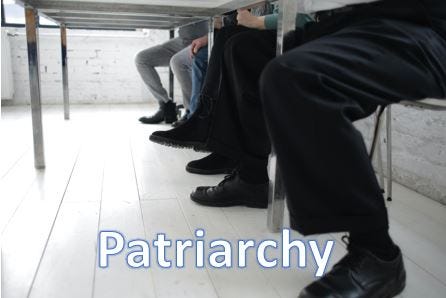
Men legs under a table with the text "patriarchy" overlaid.

Patriarchy is about believing that men are superior. Tech — and most sectors — are ruled by patriarchy.

And you bear the brunt of it

  • You don’t negotiate your salary because you think you’re not worth it, even if statistics show that 94% of job offers made are upheld after candidates negotiate them.
  • You get drowned in “naturally female” tasks such as admin and glue work — taking notes in meetings, bringing birthday cakes, and providing emotional support — while your male peers focus on promotable activities.
  • You buy on the trope that imposter syndrome is a “female thing” and spend time binging on webinars and books promising to “cure you”, rather than learning how to use it to your advantage.

The bottom line is that you’ve learned to narrow your ambition and blame yourself for it.

Two women covered of dirt on exercise atire are going over a fence. One of the has her face to the camera and looks tired.

The good news is that it’s all a lie

Here is proof

Are We Doomed to Trip Over The Same Stones Forever?

Our brain, our education, and patriarchy appear as formidable forces — and they are!

Moreover, there is no “vaccine” or “magic bullet” to erase them in the blink of an eye.

  • Our brains stay with us until we die.
  • It takes ages to “unlearn” our education.
  • Patriarchy is in the air we breathe — from the roles we take at home to our politicians and institutions.

Is there an alternative? Actually, I have two for you.

One on your own and the other with support.

Alternative #1: Do It On Your Own With 3 Questions

There are two kinds of self-awareness

  • Self-awareness about yourself — knowing what you think, feel, and do.
  • Self-awareness about others — grasping how others perceive you.

To battle the three forces that keep you from greatness— brain, education, and patriarchy — it’s imperative to focus on the first kind of self-awareness: Your thoughts about yourself.

How do you do that? You ask yourself three magical questions when you notice that you’re refraining yourself from stepping into boldness.

Question #1: What am I hearing?

You’re about to apply for a job and you hear in your head

  • This job is too demanding for me.
  • People won’t like me.
  • They’ll be disappointed when they read my CV.

Do you see how those “voices” are reproducing the “three forces”?

Question #2: What am I saying about myself?

I have the luxury of meeting amazing women every week. Weaving in our conversations, I often hear them say about themselves:

  • I’m not the smartest person but I work hard.
  • I was just lucky to get promoted.
  • I don’t know how to ask for a salary increase.

How do you expect to get inspired to try new things when you’re kicking yourself down all the time?

Question #3: What am I assuming?

This powerful question comes from my study of the ​Thinking Environment​ framework, which posits that

The quality of everything we do depends on the quality of the thinking we do first.

​Nancy Kline​

A core component of the Thinking Environment is ​uncovering untrue assumptions​

The key block to high-quality independent thinking is an untrue limiting assumption, lived as true.

What does that look like in practice? Let’s look at the example I mentioned above of applying for a job.

*Thought* This job is too demanding for me.

What assumptions am I making about the schedules and flexibility of the role?

*Thought* People won’t like me

What evidence supports my assumption that nobody in that organisation would like me?

*Thought* They’ll be disappointed when they read my CV.

What proof do you have that your CV is not exactly what they are looking for?

In summary, questions are great if you have the self-awareness required to pause and allow yourself to reflect on what’s going on in your head.

However, your brain offers you “thoughts” at a rate of ​900 words per minute​, so it’s a mighty task.

The good news is that you don’t need to do it alone.

Alternative #2: Do It With Coachering©

Board with the text "You got this" on a desk with a laptop in the foreground.
Image by LMSunday from Pixabay

Throughout my own lived experience as well as my decades of expertise as a mentor and coach, I’ve concluded that the best external support to help materialise impossible goals comes as the ideal combination of mentoring and coaching.

I called that perfect balance coachering© — a unique combination of coaching and mentoring that is personalised to the recipient, taking into account their background, current situation, and their goals.

This is how it works in practice.

As a coach

  • I provide a confidential and non-judgmental space with no distractions to uncover the reasons behind your behaviors, enabling true change.
  • Unlike self-help or quick-fix programs, I address the root cause of the issue and give you tools you can use for life.
  • I know how to motivate you to do things that you thought were impossible and keep you accountable for massive action.
  • I have a library of techniques to help you overcome anxiety, procrastination, self-doubt, overwhelm, and self-criticism.
  • I continually show you how you are growing and improving and tell you the truth without holding back.

In brief, as a coach, I help you to do what you want to do but you’re not doing.

As a Mentor

  • I share with you valuable insights, knowledge, and experience gained from my own career and personal journey, helping you to avoid common pitfalls, navigate challenges, and capitalise on opportunities more effectively.
  • I give you guidance on developing specific skills relevant to your career goals. Whether it’s leadership, communication, technical expertise, or other competencies, I can offer you advice, resources, and feedback to help you enhance your capabilities.
  • I believe in your potential, boosting your confidence. I provide encouragement, validation, and support, helping you overcome self-doubt and imposter syndrome, and empowering you to take on new challenges and pursue ambitious career goals.
  • I can advise on your career path, educational opportunities, and professional development initiatives, helping you to make informed decisions and progress more rapidly toward your objectives.

As a mentor, I leverage my knowledge, experience, and support to help you accelerate your career progression and achieve your goals more efficiently.

How do I know this works?

Some of the results women in tech have gotten from working with me are

  • A 70% salary increase within 6 months.
  • Transitioned from career ceiling to dream job within 10 months.
  • Promoted from individual contributor to manager within one year.
  • First trustee role within 4 months.
  • Got sponsorship and precious advice from experts from mastering social media and cold pitching.
  • Developed an impactful and authentic communication style that got them a promotion.

Testimonials

Patricia’s coaching was truly transformative. After returning from maternity leave, I struggled to focus on my progress amidst various challenges. Her insightful and compassionate approach helped me reframe my situation and refocus on my goals.

Thanks to Patricia, I achieved milestones I once thought were out of reach. I am incredibly grateful for her exceptional coaching and unwavering support.

Hanlin, Head of BI & Analytics.

I am happy that I’ve met Patricia in time. I am going through a career change period, which has become less frightening and more strategic.

She helped me see the patterns of how my mind is holding me back, and by the end of the coaching program, I noticed a shift in my self-confidence and resilience. In our sessions, we uncovered the root causes of my inaction, and solutions emerged naturally from her insightful questions. She also shared her wisdom and vision when I needed it.

She is passionate about coaching and empowering women and has all the necessary expertise to help. I enjoyed every session. Thank you, Patricia!

Alena Sheveleva, Research Fellow

Patricia was able to look at my experience, and then where I was right now. It literally felt like she was weaving together different strands to then hone in exactly on career blocks and give me some ideas to move past them.

Her style was to ask questions rather than give me a simple to-do list, I also liked the way I felt I could trust her professional experience. She knew what I was talking about from inside my chosen sector.

Ruth Westnidge, Software Engineer

Call To Action

Holding yourself back from applying for a new role?

Thinking your ambitions are “too big” for you?

Feeling “behind” after returning from maternity leave?

Then, pause and ask yourself the three magic questions

  • What am I hearing?
  • What am I saying about myself?
  • What am I assuming?

Or decide that you’re worthy of getting the support you need and check the Feminist Tech Career Accelerator to learn how coachering© can help you achieve your goals without burnout.

Click below to learn more about the Feminist Tech Career Accelerator

I cannot wait to meet you.

Breaking the Mold: How I Balance Job Security and Entrepreneurship

A woman in business attire with a hijab covering her hair in a modern and stylish office sat in front of a computer reading a budget report.
Photo by Cedric Fauntleroy.

I have two jobs. I have a full-time role as Director of Support for a tech corporation. This is a job that I find both fulfilling and comes with a monthly salary. I also have my own business helping leaders to make more inclusive tech products and workplaces. I love it too.

I’m often contacted by women who see my posts on social media, visit my website, or have attended one of my workshops and want to know more about how I “manage” to have a salaried job at a corporation and my own business because they’re exploring the possibility to do the same.

Last week I had three of those conversations almost back to back. Also, this year’s International Women’s Day motto was “Invest in women: Accelerate progress.” It looked to me like a sign from the universe that it was time to share some of my key insights on this topic with a broader audience.

More specifically

  • The genderisation of entrepreneurship
  • The three ways patriarchy keeps you from launching your business whilst enjoying the security of the salaried job
  • How you’re using productive procrastination against yourself
  • Three keys to my success in balancing my corporate job with my business.

Failure as a status symbol for wealthy white men

I work in tech so I often hear about privileged men parading their business failures as a symbol of status.

How does that manifest in practice? For example, somebody introduces the enterpreneur in question by  

  • Their number of failed startups.
  • The millions in investment they’ve got – and wasted.
  • The renowed universities where they drop out before finishing their degrees.

Strangely, this is no way to disparage the person but to portray them as

  • Visionary
  • Fearless
  • Experienced

Can you imagine a businesswoman introduced in the same way expecting people to be impressed by her entrepreneurial capabilities?

Neither can I.

How patriarchy is talking you out of your entrepreneurship dream

Belittling the commitment as an entrepreneur

I’ve lost count of all the people who have told me that I don’t take my business seriously because I’m “not all in”, meaning that I haven’t quit my salaried job.

In their view, if you believe in your business you should drop everything and “follow” your passion.

What do I think? That when you have the privilege of financial, social, and emotional stability is easy to lecture others.

My parents became immigrants for financial reasons and I’ve been an immigrant since I was a baby.

A major lesson of a life shaped by financial ups and downs — not only those of my family but of many the countries I’ve lived in: Spain, Venezuela, Greece, France, the UK  — has been that financial security is priceless. No pun intended.

I cannot even phantom having the luxury of tech bros of dropping from Harvard (Bill Gates and Mark Zuckerberg), Standford University (Elon Musk and Sam Altman), or the University of California (Travis Kalanick).

I never felt that “failure” could be “fun” or proof of my experience. Moreover, I never wanted to be a financial burden for those around me. All the opposite, I’ve strived to be a financial rock that people around me have been able to tap into in moments of need.

Discouragement from family and network

A recurrent theme in the conversations with those women is what those close to them think about it.

It starts with something like “My friend/partner/parent says”

  • I won’t like it
  • It’ll be too stressful
  • I don’t have what it takes
  • I’ll stretch myself too much
  • I better concentrate on my salaried job

When those fantastic women share those “pearls of wisdom” with me they often add that their friend/partner/parent knows them very well… Somehow implying that they know them better than they know themselves.

Minimisation of the business

Those women may refer to their business ideas as 

  • Hobby
  • Pocket money
  • Money for “my things”
  • Hustle

Those words minimise their business. Why? Often, because they’re afraid of

  • Failure
  • Ridicule
  • Being patronised later with an “I told you so”
  • Making others feel threatened

Referring to their business with words that make it look small and inconsequential keeps those women safe.

But it’s also a way to hide the fact that business is linked to finances. We don’t expect a hobby to bring money. A business is.

What’s driving that dissuasion campaign?

Patriarchy. 

Imagine if women would get their own business and enjoy financial freedom – who would

Patriarchy cannot tolerate that women get to have the cake – a salaried job – and eat it – their business.

How women keep their dreams alive (without acting on them)

I’ve talked at length about how productive procrastination keeps us from doing what we want to do. I refer to this term as performing tasks that are alibis for not sharing our work with others.

This is how I’ve used productive procrastination against my business

  • Resisting launching my website with the excuse that I had to keep refining the “draft” version until it was perfect.
  • Endlessly crowdsourcing advice — and secretly permission —  from many women with a salary and a business before starting mine.
  • Continually enrolling in courses to teach me all the different aspects of business — marketing, finances, accounting, and many more — with the excuse that I needed to be an expert on all areas of entrepreneurship before giving it a go myself.
  • Avoiding talking with my target client about my business idea.
  • Denying myself to invest in business mentoring and coaching because deep down I thought my business was not “worth the financial investment”, disregarding the mental toll and time spent going in circles and searching for approval from others.

But there are many more excuses that those women searching for advice have shared with me:

  • I’m not good a call calling
  • I don’t know marketing
  • It should be overwhelming to make both the salaried and business work
  • I don’t have time to do “everything”
  • I don’t know how social media works

Are those women wasting our time together? I don’t see it that way. They are fighting to get somebody to believe in their dreams despite their resistance and that of those close to them.

3 steps to get you started

To manage my transition from getting revenue only from a full-time job to developing my business and my personal brand whilst thriving in my corporate job – I was promoted to Director whilst running my business – several streams came together:

1.- Gaining awareness of my skills, background, and experience — In 2019–2020, I played with the idea of a startup focused on an app to help educate and identify unconscious biases. I went to a start-up accelerator and learned about VCs and pitches. I also painstakingly learned that it was not for me. 

Then, I had a lightbulb moment. I’d been delivering services — training, contract research, and support — for 20 years. Moreover, I’d been coaching and mentoring women in tech for as many years if not more. 

Since that moment, I haven’t looked back. I’ve made all those hard-earned skills the core of my business offer.

2.- Developing a personal brand — A very dear mentor and sponsor of mine told me years ago, “Patricia, you’re your brand.”

In retrospect, I realise that I didn’t understand what she meant. Brand sounded like something influencers and big companies like Coca-Cola and Nike had, not me. Since then, I’ve invested significant money and time in addressing my gaps in that area. 

For example, learning how to 

  • Craft articles that people want to read — initially, only my family would read them but today some of my pieces have been read by more than 3K people.
  • Get consistently +1,000 monthly visits to my website
  • Become a paid speaker

All have taken effort — not only grasping the “know-how” but adapting it to the vision, mission, and values for my business.

3.- Managing my mind so I move from “thinking” to “doing” — From setting impossible goals to motivating myself to do the things that I need to do and I’m not doing, I’ve had to learn strategies to work through and sometimes around my limiting beliefs.

And I often get the following up questions

  • Which of the three was the hardest for you? Of the three, the toughest one has been #3. Whilst #2 can appear as the most time, effort, and money demanding, I love learning and I use it to procrastinate on tasks that I want to do but I’m not doing.
  • In which order should I do the steps? Chances are that your business is going evolve as you test your offer with potential clients, so the reality is that you’ll need to keep coming back to the three of them.

A final piece of advice — check the conditions in your salaried contract regarding setting up your own business. Some organisations are more flexible than others.


My business is allowing me to explore complementary sides of myself like creativity, entrepreneurship, branding, and systems thinking. If you’re thinking about keeping your salaried job and starting your own business, I hope you have a journey as rewarding as mine.

And if you’re going in circles questioning if you should or shouldn’t have a dual role like mine, I invite you to think about what would you do right now for your business idea if you knew you couldn’t fail.

And then, go and do it.


Feminist Tech Career Accelerator

Three things are keeping you from getting the tech career you deserve

Your Brain * Your Education * Patriarchy

Thrive In Your Tech Career With Feminist Guidance

Achieve your career goals * Work smart * Earn more

Click below to learn more about the Feminist Tech Career Accelerator

Unmasking Role Model Myths: Crafting Your Unique Path in Tech

White unicorn walking over the sea under a rainbow. Above the rainbow the text "Role Model".
Figure adapted by Patricia Gestoso from this orignal image by Sabine Zierer from Pixabay.

A week ago, I delivered a virtual keynote to a group of women in tech. The title was “Breaking Models: The Three Keys to Success That You Already Possess”. I wanted to inspire them to rely on themselves — rather than on external role models — to achieve their goals.

During the talk I shared

  • The contrast between my career in 2017 and now.
  • How the process of launching my website on diversity and inclusion in tech in 2018 became a pivotal moment in my professional career.
  • How the emphasis on “role models” and the mantra “You cannot be what you don’t see” hindered my professional progression.
  • Three tools that can accelerate our career advancement and that we already have in ourselves.

The feedback from the attendees was so positive that I decided to share the highlights more broadly. 

Let’s start with some context about the attendees.

The audience

Venezolanas in Tech (ViT) is a nonprofit organisation aiming to give Venezuelan women and young girls the opportunity to develop their professional skills, gain exposure to job opportunities in tech, and find a safe space where they can meet others who are facing similar challenges.

Last January, I was approached by the organiser of their mentoring program to give a talk. She shared

  • The ask —  To be their keynote speaker for the last session of the mentoring program. 
  • The audience — Many of the women in this mentoring cohort were in the process of transitioning, either between different tech roles, arriving from a different sector into tech, or coming back to tech after a hiatus working in another industry.
  • The topic —As the common denominator among the audience was reinvention, the organisers believed that many of the mentees might be wondering what to do after the program ended. They wanted the talk to inspire them to continue on the path they’d started.

As a native Spaniard who also holds a Venezuelan passport and a woman in tech, I couldn’t say no to them.

The transformation: From Patricia v.2017 to v.2024

My LinkedIn profile portrays me as a successful tech professional with a reasonably straightforward corporate career.

It didn’t feel like that seven years ago.

Patricia v.2017

I shared with the audience a photo of myself smiling in Paris, more precisely, in front of the Arc de Triomphe, in 2017. I was there for a company meeting.

The image was of a “happy” Patricia but underneath I was very disappointed with my career progress.

At the time, I had been Senior Manager of Scientific Support for 5 years. I had learned that I was considered a high performer with low potential. I had reached my career ceiling.

I was also stuck regarding my diversity, equity, and inclusion (DEI) impact.

In 2016, I founded the first gender employee resource group in my workplace. A year later, I was eager to participate in the public debate about the role of diversity and inclusion in organisations. However, I kept postponing it month after month, preferring to reserve those conversations for discussions with like-minded work colleagues.

Patricia v.2024

Today, I have a fulfilling — even if somehow unusual— portfolio career 

  • I’m a Global Director of Scientific Support and Customer Operations for a Fortune Future 50 corporation.
  • I have a business as an inclusion strategist where I help tech leaders leverage diversity in their business strategy to boost innovation, protect their reputation, and attract and retain talent. I also help non-tech C-suit and board members seize responsibly AI opportunities.
  • I’m a certified work-life coach who helps ambitious women in tech make more impact, work less, and design a life that they love.
  • I volunteer for European Women on Boards, an NGO with the mission to increase gender equality in decision-making; We and AI, a British NGO that aims to increase public awareness about the benefits and challenges of AI; and I’m a trustee of the Booth Centre, a community centre run with people affected by homelessness.
  • I’m a writer and a keynote speaker. I’ve published research on the effect of covid-19 on the unpaid work of professional women and I’m writing a book about how women succeed worldwide based on feedback from over 400 women in tech living in 60+ countries.

But I’d lie if I said the transition was seamless.

The path to launching my website 

I first thought about launching a website dedicated to the intersection of DEI and tech in 2016. But I became a master at talking myself out of it.

I told myself that 

  1. I was not a DEI expert — I compared myself to people who had the title of Head of DEI or who had written books about unconscious bias. Without a diploma in Human Resources, who I was to be vocal about diversity and inclusion in public?
  2. My “Good Girl” manual — I had been socialised to believe that it was not serious for a woman with engineering and Ph.D. diplomas to take a 90-degree turn and “waste time” focusing on DEI.
  3. Perfectionism — As Brené Brown says in Men, Women and Worthiness, many women are raised with the expectation of perfection. I never had a blog on DEI or any other topic. Still, I had decided that if my blog ever had a typo, it would have catastrophic consequences for my reputation. It was either perfection or nothing.

What I discovered through a journey of deep introspection and coaching was that

  1. I was protecting myself from criticism — Starting a public blog in DEI exposed me to others questioning both my views and the relevance of my background to speak about the topic.
  2. I was hooked on praise —My worth was tied to others’ appreciation of my work. I was concerned about what my professional and personal network would think of me if I started a blog about DEI.
  3. I thought I needed to find a role model —At the time, the only people working in tech that I knew were interested in DEI were those on the HR team. As I didn’t know anybody who worked in tech and had a blog on diversity and inclusion, I repeated to myself that “I couldn’t be what I couldn’t see.”

From the three, let’s focus the “need” to find a role model as a prerequisite to stretch ourselves out of our comfort zone.

The myth of the “role model”

There are three top reasons why focusing on finding a role model didn’t help me

  1. I fell into productive procrastination — Whilst searching for my “elusive” role model, I would spend my time busy with further certifications, courses, and workshops creating the illusion that I was working towards building my website. It was a lie, I was procrastinating.
  2. I used comparison against myself— Once I found my unicorn — aka “role model” —I proceeded to dissect how great they were and find shortcomings in myself. I am the same age as Sheryl Sandberg. When I read Lean In in 2017, the gap was obvious. She had been a student at Harvard University, VP at Google, and at that time she was already a millionaire and COO at Facebook. I felt like a failure.
  3. I missed my uniqueness — By trying to find and imitate a role model, I discarded what made me distinctive: the combination of having a strong scientific and technical background, a career in services in tech, and experience living in 6 countries on 3 continents.

Luckily, there was another way. What if I already had the role models I needed? What if you already have them too?

The three tools we all possess

Our past self

We use our past to berate ourselves. 

My blog and my promotion to director have brought me joy and recognition. It’s easy to look back at Patricia v.2017 and recriminate her for neither getting the director role after five years as a senior manager nor being bold enough to start her blog until 2018. She used to be my punching ball.

Instead, what if we flipped the script and took the time to thank our past selves for believing in our potential?

For example, I’ve learned that I can access the memories of Patricia v.2017 to give me confidence when things don’t go as planned or take longer than expected.

In those moments, I pause and thank her for believing that Patricia v.2024 was possible. For not giving up on me — her future self — when people around her told her to put her head down and continue to do what she was doing.

IN PRACTICE: What relation do you have with your past self? Do you use it to reprimand yourself or to energise you? 

Our present self

Sometimes, I use “time” as a tactic to talk myself out of what I want to do but I’m not doing. For example, I tell myself

  • Writing an article takes a lot of time.
  • I don’t have enough time to network.
  • It’s impossible to manage my corporate career, my volunteering work, and my business.

In those moments, I also default to using verbs like “should”, “have to”, or “need” to catastrophise about my stretch goals.

  • I should be posting every day on social media to grow my business.
  • I must write a new article every week to show I’m serious.
  • I need to network to be a successful businesswoman.

Notice a pattern? In those moments, I talk to myself like a victim of my business, my writing, and my time management skills. 

Alternatively, I can stop being a martyr of my stretch goals and become a strategist of my life. In those moments, that’s how I talk to myself

  • I decide to spend one hour per day on social media to build my brand as an inclusion strategist and technologist.
  • I choose to spend my Sunday writing articles because I want to share my point of view about tech, DEI, careers, and feminism with others.
  • I prioritise networking in my business because it helps me to find clients, connect with interesting people, and explore synergies.

In summary, I talk to myself as the person who has authority over my life.

IN PRACTICE: Which kind of language do you use to prompt yourself into action? Do you treat yourself as a victim or as a decision-maker?

Our future self

We talk endlessly about SMART goals — objectives that are Specific, Measurable, Achievable, Relevant, and Time-Bound.

SMART goals are great when we want to play it safe and have a plan in place to reach our objective.

But what if you are a trailblazer? What if you want to escape a cookie-cutter life?

If you’re not convinced yet, can you imagine Mahatma Gandhi, Emmeline Pankhurst, Nelson Mandela, and Florence Nightingale accomplishing their bold vision by using SMART goals?

Let me introduce you to impossible goals. Those are goals that are so bold that you don’t know how to achieve them. Yet.

There are four key benefits of setting impossible goals

  • They remove limiting beliefs you didn’t know you had about what’s possible for you.
  • They teach you to embrace uncertainty.
  • You discover that you can trust yourself to learn what you need to know to achieve your objective.
  • You transform yourself through the journey to attain an impossible goal.

Tempted? This is how it works.

In 2022, I coached 5 women and they got the promotion they wanted. In 2023, my impossible goal was to coach 50 women and people from underrepresented groups to get the promotion they deserved. 

I’m happy to report that I coached 58.

Was it easy? No. Did I know how to do it when I set the impossible goal? No. But by trusting my future self — that version of Patricia that would have already succeeded — and using it to help me focus when I wanted to give up, I exceeded my impossible goal.

IN PRACTICE: What outrageous goal do you want to achieve? Now, imagine who you’ll be once you reach that goal. How does that feel?

How to use your three role models at a juncture

In June 2018, I finally launched my website. It was not perfect then and still isn’t today. But it has been an incredible laboratory to learn about myself and show me what I’m capable of when I rely on my own role models rather than wait for external inspiration.

How can we use those three tools when we are at a crossroads, like ending a mentoring scheme, completing a degree, or feeling that we’ve outgrown our current role?

In those moments, there are three typical traps where our past, present, and future selves can help us.

Ruminating about the past

When we complete a chapter in our personal or professional career, we may look backward and reprimand ourselves for the things we did and didn’t do. 

For example, we may scold ourselves because we missed the opportunity to connect more often with our mentor, regret the classes we missed at the university, or lament that we didn’t invest more time in broadening our network. 

Instead of having a pity party, go back in time and remember that version of yourself that signed up for the mentoring scheme, started the degree, or applied for the job you have. And then, thank your past self because they made a decision from which you’re benefiting today. 

The upside? Reminding your brain that you’re a person who makes sound decisions.

Trapped in analysis-paralysis

We may be fretting about what road to take as we feel “on our own” after reaching a milestone – worrying about wasting our time, making the wrong decision, or missing out on the opportunity of a lifetime.

Don’t let your brain make you a victim of the present. Be your own ally. 

Rather than stressing out about the “right choice” and “the lack of time”, I dare you to believe that

  • All alternatives are valid — Your job is to pick one and then tell your brain the reasons why you like your choice. 
  • It’s possible to timebox tasks — You can decide in advance how much time you want to dedicate to an activity rather than working on the assumption that tasks “take the time that they take”.
  • Done is better than perfect.

Feeling uncertainty about the future

When we complete a phase in our career, it may be hard to get past the obstacles we foresee in our future: Our first job application, asking for a promotion, or starting our own company.

Here is where your future self can be priceless as your mentor and guide.

Imagine the version of you who already got the job you want, was promoted, or is a successful entrepreneur. Then, use it as your mentor and guide. 

  • What advice can they give you about your next steps?
  • How can they inspire you to continue working on your goals? 
  • How can you use them as accountability partners when you are tempted to give up on your objectives? 

I want to thank me — for believing in me and doing what they said I could not do. And I want to say to myself in front of all you beautiful people, “Go on girl with your bad self. You did that.”

Niecy Nash-Betts, Acceptance speech after winning the 2023 Emmy Best Supporting Actress Award

Stop searching for external role models. 

Instead, learn to appreciate your uniqueness and talk to yourself — past, present, and future versions — like your friend, mentor, and coach, rather than your most hated enemy.

Ready to become your own role model? Let me know what you think in the comments!

Feminist Tech Career Accelerator

Three things are keeping you from getting the tech career you deserve

Your Brain * Your Education * Patriarchy

Thrive In Your Tech Career With Feminist Guidance

Achieve your career goals * Work smart * Earn more

Click below to learn more about the Feminist Tech Career Accelerator

Defying Patriarchy: Strategies for a Joyous New Year’s Celebration

Christmas dinner table with a white millennial man sat at the top of the table flanked by an old white couple on his right and two brown children on his left. On the other side of the chlidren there is a millennial brown woman lighting the candles on the table. The millennial man and woman smile.
Let’s guess who prepared the Christmas dinner. Photo by cottonbro studio.

The period between Christmas and New Year is supposed to be a moment for families to reunite, share traditions, and celebrate.

Under that benevolent facade, patriarchy and its ally misogyny are plotting in plain sight. 

Let’s revisit three patriarchy’s ghosts of Christmas past and discover three strategies to break free from their grip in time for New Year’s celebration.

Three patriarchal principles that underpin this holiday season

There are many ways this time of the year enforces patriarchal norms and processes. 

Note that I’m not talking only about sexism — the division of labour based on gender, e.g. women shop, cook, and care for others whilst men converse with the visits  — but it’s how we do it. 

It’s in the “how” that patriarchy has a field party. Three of its principles particularly shine during this time of the year. Each of them reinforces the others.

Let’s get cracking!

Principle #1: Women are responsible for the “perfect” holiday season

As I discussed before in this article about the patriarchal value of time and women’s unpaid work, women are perceived as “human doings”, not human beings. That means that our worth is correlated with what we “produce” for others.

And what does that mean during this time of the year? That somehow the Powers that Be have bestowed upon women the duty of creating the perfect holiday season for those around us.

BTW, no need to worry about what perfection looks like— leave it to social media, magazines, TV shows, and even ChatGPT to give us their “feedback” on 

  • Cooking the perfect Christmas dinner
  • Choosing the perfect wine
  • Setting the perfect New Year’s Eve table
  • Decorating the perfect Christmas tree
  • Picking the perfect gift for everybody else

And the list goes on, personalised for each family member, friend, and acquaintance. 

Of course, women don’t escape either to this quest for perfection. The perfect body, hairstyle, shoes, and skin complexion are dictated by our always-evolving patriarchal standards and are now reinforced by AI, as the research by The Bulimia Project has surfaced.

As that to-do list is not enough, women are also required to care for everybody else’s emotions.

And how do they achieve that? Go to the next principle.

Principle #2: Women’s job is to make others happy

Patriarchy wants us to believe that everybody depends on women for their emotions. We can magically make them happy, sad, frustrated, appreciated… and so on.

The underlying theory is that people around us are emotional children and whatever women do/don’t say or do will impact their emotional wellbeing.

As the Christmas to New Year period is marketed as “the happiest time of the year” in most of the Western world, women bear the brunt of not “screwing this up” for everybody.

As a result, we should deploy our “innate” social skills and guess when to act as 

  • The cheerleader
  • The listening ear
  • The supporter
  • The clown
  • The role model
  • The confidant
  • The graceful host
  • The helpful guest
  • And even the self-deprecating joker.

Failure to cater to everybody’s mood and needs indicates a “lack of empathy” — a capital sin for women — and, more importantly, selfishness.

Speaking of which, let’s check the last principle.

Principle #3: Women are selfless 

What happens when making other people happy conflicts with women’s happiness? That’s easy. By default, our own happiness is at the bottom of the list, buried under others’ needs.

This manifests as

  • Demands on women’s time and attention — who said that Christmas was a period of relaxation for everybody? The reality is that for some to be able to rest and enjoy the holiday, others — women — need to do the work.
  • Opinions on women — This time of the year women are supposed to shut up and stoically endure jokes and opinions about how we live our lives. Why we don’t have children, have too many children, or not enough children. Why do we have a paid job, work part-time, or don’t have paid employment. Why we’re divorced, lesbian, single, or bisexual… and the list goes on. There is no question intimate enough that’s off-limits provided that the setting involves enough people that can be “upset” if we fight back. And if in doubt, watch or read Bridget Jones’s Diary.
  • Entitlement to voice entrenched stereotypes and discriminatory beliefs — somehow this season appears to foster the perfect conditions for people to feel emboldened to express racist, sexist, and ableist remarks — as well as any other prejudiced statements against underrepresented groups like immigrants and trans people — expecting to get reassurance from the audience or at least no pushback. And knowing that their host or a female guest is specially engaged in DEI activities is far from a deterrent. Instead, the person should expect to be publicly named and warned that resistance is futile, e.g. “Mary, I know you’re [feminist, defendant of gay rights, DEI activist, etc..] BUT you should agree that [prejudice, stereotype, bias]”.

Women are expected to accept these additional burdens gratefully, as setting any kind of boundaries somehow will destroy the illusion of harmless banter and festive spirit.

Three strategies to fight back against a patriarchal holiday

But not all is lost. Three coaching tools can help you minimise the impact of patriarchy on your enjoyment of this holiday season.

Strategy #1: Embrace emotional adulthood

What if people’s emotions didn’t depend on you? For good or bad, others’ emotions depend on them. More precisely, on their thoughts about circumstances.

Don’t believe me? Then, remember the expression ”Is the glass half empty or half full?” The premise of this famous question is that the same fact can be framed as a positive or a negative, depending on how you look at it.

In contrast to emotional childhood explained above, emotional adulthood is when we believe that people’s emotions are dependent on them and not on us. The reality is that if Aunt Maud is sad because you didn’t invite Uncle Sam to the dinner, it’s not you that causes her sadness but it’s what she’s making it mean.

Next time you’re put on the spot as “causing” somebody’s negative feelings, I invite you to hold tight and resist the emotional blackmail from those around you and instead believe in their power to manage their own emotions.

Strategy #2: Aim for B- work

This is what I’ve learned about perfection

  • It’s ill-defined — what’s perfect one day, can be a mess later on.
  • It’s overvalued — when you look back on your life and reflect on the moments that have brought you joy, chances are that by no means they were “perfect”. For example, last summer my mother broke her hip and I remember my joy at seeing her walking after the surgery. Would the moment have been better if we both had perfect hair and makeup? The answer is no.
  • Makes people feel inadequate —we’re taught that perfection is a gift to others and ourselves. I disagree. It’s often poisoned candy as it leverages comparison to make some people feel like winners at the expense of others feeling like losers.
  • Our worth doesn’t depend on “producing” perfection — We’re already worthy as we are.

My solution to perfectionism? Aiming for B- Work. 

Just to be clear, not only I’m telling you not to go for perfection or even excellence, but I’m recommending you aim for good going down to satisfactory.

If in doubt, imagine how planning for good — instead of perfect — could give you back

  • Time
  • Energy
  • Peace of mind

Isn’t worth a try?

Strategy #3: Decide ahead of time

I’ve talked about this strategy before in this post where I discussed the power of integrating quitting your job into your career success strategy.

Deciding ahead of time is to plan how you’ll think, feel, and act in advance of certain triggers appearing. 

For example, how will you react when

  • Cousin Alex treats you like their personal bartender and waitress during the dinner you’re hosting.
  • Uncle John asks you — like every Christmas — why are you still single.
  • Niece Jenny complains — again — about how immigrants steal “all jobs” and also claim “all benefits” somehow forgetting to notice that you’re an immigrant too.

Note that when I say “deciding ahead of time” this includes choosing not to do anything at all, including smiling or leaving the table to make it look like you forgot something in the kitchen. Moreover, you can even come up with a list of things you won’t do! 

In the end, the goal exercise is about allowing yourself to choose in advance what works for you.

Conclusion

The Christmas to New Year period is full of patriarchal dos and don’ts. It’s also ripe for disruption. 

Let’s start right now.

BACK TO YOU: What patriarchal principle makes it harder for you to enjoy this holiday season? 


Feminist Tech Career Accelerator

Three things are keeping you from getting the tech career you deserve

Your Brain * Your Education * Patriarchy

Thrive In Your Tech Career With Feminist Guidance

Achieve your career goals * Work smart * Earn more

Click below to learn more about the Feminist Tech Career Accelerator

Upwards & Onwards: The career breakthrough gift you deserve in 2024

Four women of different ethnicities and ages in business casual attire in an office. They are standing up and have their arms crossed. They smile.

One of the things I’m proudest of this year is the launch of my “coachering” — coaching & mentoring — program “Upwards & Onwards”. 

Through this program, women and people from underrepresented groups have got

  • An internal promotion.
  • A job in another organisation more aligned with their career goals.
  • A more senior job in another organisation.
  • Applied for internal promotion and received detailed feedback on the skills and experiences needed to get the promotion next time around.
  • A substantial salary increase.
  • Both a promotion and salary increase during maternity leave.
  • Transitioned from a post-doctoral position at the university to a permanent role in a corporation.

What makes this program different from any other career program? 

This program provides both coaching and mentoring because we need both to succeed in a career that is also integrated with our personal life.

I’m a certified career and life coach as well as an award-winning inclusion strategist and technologist with 20+ years of experience in digital transformation and people management.

My background gives me unique insights into technology, bias, inclusion, equity, management, career growth, and behavioural science to help women and people from underrepresented groups to become successful on their terms whilst embracing kindness, joy, and self-compassion.

In addition to my coaching certification, I bring to the table

  • 18+ years mentoring and coaching women and people from underrepresented groups such as ethnic minorities, disabled people, and immigrants.
  • 15+ years of experience as a manager (including hiring, onboarding, promoting, firing, and layoffs).
  • Experience spearheading numerous initiatives to promote diversity and inclusion in tech that was recognized with the UK 2020 Women in Tech Changemakers award.
  • Featured in the Computer Weekly 2022 and 2023 longlist of the most influential women in UK tech.
  • DEI advisor for We and AI, a British NGO with the mission of making artificial intelligence work for everybody.
  • UK Committee Member for European Partnerships & Memberships for European Women on Boards, an NGO that supports the European Union’s Directive that introduces a binding objective of at least 40% of board members of each gender by 2026.
  • STEM degree (B.Sc., M.SC in Chemical Engineering, Ph.D. in Computational Chemistry)
  • A global perspective acquired by living in 6 countries on 3 continents and building professional and personal relationships with nationals of more than 50 countries.
  • Trilingual: English, French, and Spanish.

Imagine yourself a year from now. 

  • You have a new role that aligns with your definition of success.
  • Your work and personal lives are integrated rather than fighting each other.
  • You feel you’re fairly compensated for the work you do.

What between you and that future self? 

  • Self-doubt.
  • Self-criticism.
  • Limiting beliefs.
  • Fear of uncertainty.
  • Misinformation about how to advance your career.
  • Unawareness about how office politics work.

In this program, you will

  • Examine where are you in your career
  • Decide on your next bold professional move and ensure that it integrates into the lifestyle you want for yourself.
  • Identify the gaps between where you are and where you want to be.
  • Create a plan.
  • Implement the plan.

Want more details? Keep reading!

Three women on their 20-30s of different ethnicities sat around a table smiling. Two of them are high fiving each other.

Upwards & Onwards: Coaching and mentoring program

Are you tired of waiting for the Powers that Be in your organisation to recognise the amazing work you?

Do you have enough of seen less skilled people to get promoted ahead of you?

Do you feel overworked and underappreciated?

That’s my story too and this is how I changed it.

My career promotion story

The idealized version of my career path is that I started as a training scientist for a mid-size tech company and I’m now Global Director of Scientific Support and Customer Operations for a Fortune Future 50 tech corporation. Wow!

The real version is much less dreamy. To get where I am now, I changed departments twice. I was passed over for promotion several times. I wasted precious time — especially at the beginning of my career — working extremely hard and waiting for others to realise the great work I was doing.

Maybe, the most interesting fact is that despite being a person who spent many years in the university learning how to do things — I have a Chem. Eng. B.Sc, M.Sc., Ph.D. as well as a post-doc — I simply assumed I knew how to get promoted, even if nobody had taught me how to do it!

What could I have done better?

Life is not a movie or Instagram, so we should expect challenges along the way.

Still, the major problem was that I assumed I had to figure it all out by myself. Or at most, with the advice of one or two friends or peers who wanted to help me out but didn’t have more direct experience than I had.

Through the years, I discovered that whilst I confronted my share of bias in my career, I had also internalised a long list of limiting beliefs. Uncovering them and putting a plan to neutralise them took coaching, mentoring, sponsoring, and, above all, time and effort towards understanding how to showcase my strengths and value to the business.

In addition to progressing faster in my career, by knowing what to expect, I could have enjoyed more the ride and felt less frustrated.

How can you go faster and make it easier?

I know that for me it wasn’t enough to discover the career promotion myths or how to counter them. It has taken mentoring, coaching, learning about behavioural science, my experience as a manager for 15+ years, and very time-consuming trial-and-error experiments.

I wish my past self could have learned from my present self how to get the next promotion.

That’s why I’ve created the 3-month “Onwards & Upwards” Career Promotion Breakthrough Program so you claim your power back and thrive in your career in 2024.

Smiling Asian businesswoman working at women and making a video call.

What’ll you get from “Upwards and Onwards”?

In this program, you will

  • Get clarity on your career goals and your next career move.
  • Examine your limiting beliefs, understand how they impact your career progression, and how you can overcome them.
  • Learn to befriend uncertainty to embrace new challenges.
  • Understand how to build your professional and personal support ecosystem.
  • Gain awareness about your negotiation comfort zone and enrich it with complementary approaches to enhance your career prospects.
  • Experiment with powerful communication styles that are aligned with your strengths and values and resonate with your interlocutors.
  • Reframe office politics as a tool to help you get things done, build relationships, and access opportunities.
  • Build the habit of lifting others as you climb.
  • Embrace self-coaching as a tool to build resilience.

Through our 1:1 work, you’ll gain interpersonal skills and learn tools that will strengthen your professional career.

What if you’re just starting a new role?

Getting promoted is a process. The earlier you start putting in place a strategy and acting on it, the higher the chances of success once you’re ready to get that promotion.

What’s the scientific evidence that this method works?

As somebody with an engineering, master, and Ph.D. degree, in addition to my years coaching individuals in my role as manager, it was important to get a certification that accredited me. Not only for the “title” but because I wanted to add further skills to my toolkit and get supervision.

Also because of my academic background, I’m keen on scientific evidence that proves the methods I use.

That’s the reason I was delighted to learn recently that the methodology I was certified on has been backed up by two peer-reviewed articles published in 2022 and 2023

“Effect of a Novel Online Group-Coaching Program to Reduce Burnout in Female Resident Physicians A Randomized Clinical Trial” JAMA Netw Open. 2022;5(5):e2210752.

Findings: In this pilot randomized clinical trial of 101 female resident physicians, participants who were randomly assigned to a 6-month group coaching program and a follow-up survey had a statistically significant reduction in emotional exhaustion and self-doubt, and an increase in self-compassion.

“Online Well-Being Group Coaching Program for Women Physician Trainees A Randomized Clinical Trial” JAMA Netw Open. 2023;6(10):e2335541.

Findings: In this randomized clinical trial of 1,017 women trainee physicians, participants randomly assigned to a 4-month group-coaching program had a statistically significant reduction in all scales of burnout, moral injury, and impostor syndrome, as well as improved self-compassion and flourishing, compared with the control group.

Testimonials

“I am happy that I’ve met Patricia in time. I am going through a career change period, which has become less frightening and more strategic.

She helped me see the patterns of how my mind is holding me back, and by the end of the coaching program, I noticed a shift in my self-confidence and resilience. In our sessions, we uncovered the root causes of my inaction, and solutions emerged naturally from her insightful questions. She also shared her wisdom and vision when I needed it.

She is passionate about coaching and empowering women and has all the necessary expertise to help. I enjoyed every session. Thank you, Patricia!”

Alena Sheveleva, Research Fellow

“Patricia has excellent knowledge and expertise on mentoring / coaching, in particular leadership for women. I greatly benefited from working with Patricia and found the experience & learnings extremely valuable for my own personal development and overall career growth.”

Aisling Mulhall, Events Senior Manager, Software company

“Patricia knows how to ask the right questions to let you come to the right conclusion and decide on next step in the journey. Patricia dared me to step out of my comfort zone”

Jolanda Bussner, Project Manager, Software company

I had the opportunity to work with Patricia through a coaching scheme at work. I personally got a lot out of the joint coaching sessions. Patricia has the skill to come across as supportive so you feel safe but she also will challenge you about why you think that way or what made you approach it from that angle, not this. There’s no judgment from her as she questions you, you can tell she’s just trying to understand everything. I hope to have the opportunity to work with her in the future.

R.B., Senior product designer

Patricia is an extremely knowledgeable and caring coach. In my short session with Patricia, she helped me to envision a future I want for myself and create a plan for that by myself. For a senior university student, Patricia was an insightful companion who supported me in navigating my career choices and living a happy life.

T.T., 4th year Economics Honours student at the University of British Columbia

Patricia was able to look at my experience, and then where I was right now. It literally felt like she was weaving together different strands to then hone in exactly on career blocks and give me some ideas to move past them.

Her style was to ask questions rather than give me a simple a to-do list, I also liked the way I felt I could trust her professional experience. She knew what I was talking about from inside my chosen sector.

Ruth Westnidge, Software Engineer

Patricia’s empathetic approach enabled me to work through my difficulties and find new ways of approaching my work projects.

The dedication and commitment she brought to our sessions gave me the confidence and encouragement to identify what was holding me back and to find possible solutions. Her insights always kept me focused on putting into action steps that would achieve results.

I gained enormously from my sessions with Patricia. Her experienced questioning guided me through a difficult period of transition from a career in the television industry to a new phase in my working life.

Bren Simson. TV director, author, local historian and guide

For more testimonials, go here.

Questions? Get in touch.

Myth-Busting Women’s Careers: The Truth About Collaboration and Empathy

A woman and a man are sitting close to each other and the woman's hand rests on the men's shoulder like providing support.
Photo by SHVETS production.

This year I ran the quiz “How much is patriarchy ruling your life and career?” As I mentioned in this article, 94% of you believe that “you should be able to achieve a life-work balance.” 

What was the next top patriarchal belief among the survey respondents? 67% of you answered that “Women are naturally more collaborative and empathic.”

Let me demonstrate to you that this “collaboration and empathy female gene” is a myth that hurts women’s careers and what to do instead. 

Women are “more” collaborative

Human beings are gregarious species. And it’s not fortuitous. We are rather weak animals and we cannot thrive on our own. We need the protection and support of a group to survive.

This interdependence is especially important for humans before reaching adulthood. Some researchers even hypothesise that the human capability to speak was first developed among our ancestor mothers prompted by the need to communicate the complexities of caring for human offspring

But it’s not only about language. Humans and their ancestors have hunted, fished, and farmed together for two million years

So, if as a species we don’t have any other choice than to be collaborative, how come this characteristic is perceived as a “feminine” trait? Because it serves the patriarchy to thrive and women to survive:

  • The myth that “women are naturally collaborative” is an excellent cover-up to shove all the non-promotable admin work to women — office work —  and feel comfortable claiming weaponised incompetence — faking incompetence at any one task (usually an unpleasant one) to get out of doing it.
  • Society teaches women that we’re “human doings” rather than “human beings “— our “worth” is perceived to be attached to what we do for others rather than inherent to being a person. Hence, women collaborate as a way to show how valuable they are.
  • Women belong to a lower-power group so they don’t have the choice to be — or appear to be — collaborative with other low-power individuals to achieve their objectives, especially if those goals challenge the status quo. 

The female empathy

I’ve written about empathy before prompted by of all the hype, mysticism, and abuse around this word. 

Simply put, empathy is our ability to guess how other people feel, what their emotions are. They are guesses because we cannot feel others’ feelings —  emotions are constructed by us. As psychologist and neuroscientist professor Lisa Feldman Barrett says “The [facial] expressions [of emotion] that we’ve been told are the correct ones are just stereotypes and people express in many different ways.”

Dr. Feldman Barret posits that we’re taught those “emotion concepts” by our parents

You don’t have to teach children to have feelings. Babies can feel distress, they can feel pleasure and they do, they can certainly be aroused or calm. But emotion concepts — like sadness when something bad happens — are taught to children, not always explicitly.

That’s for example the reason that in our culture we have the “sadness” emotion concept but Tahitian culture doesn’t. “Instead they have a word whose closest translation would be “the kind of fatigue you feel when you have the flu.” It’s not the equivalent of sadness, that’s what they feel in situations where we would feel sad.”

So, humans “learn” about emotions and the expectations from others about how to express them since we’re babies, without gender distinctions. Then, why women are the “empathic” ones?

Let’s see what are our expectations from an “empathic” person:

  • Mimicking the emotional state of the other person in our face and body — if a person cries, an empathic person should “look” sad.
  • Labeling and reassuring the other person’s feelings — when a person complains, an empathic person may respond “I can see why you’re so frustrated”.
  • Providing support — when a person shares that they are sad, an empathic person may offer a hug or a comforting hand on their shoulder and ask what they can do to alleviate the sorrow.

It sounds like a lot of effort, doesn’t it? That’s the reason patriarchy has assigned it to women:

  • If we’re genetically programmed to be empathic, it’ll be our obligation to be attuned to others’ needs and, as a consequence, fulfil their demands.
  • We’ll be expected to clock countless hours towards emotional labour— checking the team’s mood and being the emotional caregivers of the workplace. 
  • Assigning all carework to us will be a no-brainer — we’re genetically pre-programmed to “sense” others’ needs.

Moreover, this expectation of women as “empathic beings” is so strong that many women on the autism spectrum grasp that they can “pass” as neurotypical by using rehearsed catchphrases, such as “good grief”, “interesting” or “that’s amazing”. It’s called masking. In other words, making believe they are “empathic”, that they can mirror others’ emotions.

What about men?

Women expect other women to be collaborative and empathic by default. Otherwise, we label them “bad women” and wish them hell, as Madeleine Albright did in her keynote speech at the Celebrating Inspiration luncheon with the WNBA’s All-Decade Team in 2006.

“There is a special place in hell for women who don’t help other women.”

Whilst we women are very busy throwing bricks at other women, men reap the benefits of being seen as collaborative and empathic (not too much though, otherwise, they lose “toxic masculinity” points with their colleagues). What does that look like?

  • We overpraise men that show any kind of collaborative or empathic behaviour — no matter how small.
  • We absolve men for not pulling their weight and for disregarding the impact of their actions on others. After all, “boys will be boys”.

The good news: Collaboration and empathy are learned skills

We’ve forgotten that we teach children to share their toys and play together as well as to “read” other people’s emotions. Instead, we have bought into the patriarchal tropes about women’s natural talents. 

But there is a remedy. If we acknowledge that collaboration and empathy are learned skills, that means that 

  • People can teach them.
  • People can master them.
  • People can be held accountable.

Conclusion

The belief that women are naturally more collaborative and empathic is a social construct reinforced by articles, books, and social media. When we stand by it, we reinforce the patriarchal status quo.

On the flip side, we have a lot to gain by remembering that collaboration and caring for our communities are learned skills.

Your homework:

  • Allow yourself not to be collaborative or “empathic” when it doesn’t serve you well (for example, when you’re snowed under by “office work”).
  • When colleagues hide their rudeness and individualism behind gender tropes around empathy and collaboration, remind them that those skills can be taught and learned, as we do with children.

BACK TO YOU: Where do you stand on the genetic predisposition of women for collaboration and empathy?


Feminist Tech Career Accelerator

Three things are keeping you from getting the tech career you deserve

Your Brain * Your Education * Patriarchy

Thrive In Your Tech Career With Feminist Guidance

Achieve your career goals * Work smart * Earn more

Click below to learn more about the Feminist Tech Career Accelerator

Unmasking Work-Life Balance: Breaking Free from Patriarchy One Myth at a Time

Woman juggling balls with two girls. All of them dress in similar attires which elitics a feeling that they are related to each other.
Photo by Ron Lach.

Dear reader,

Each time you’re confronted with a choice, what you do depends on how you think and feel about that decision. Let me show you what I mean with an example:

  • If you see a job advertised and you think “I already have 60% of the requirements”, that may make you feel energised and prompt you to apply.
  • On the other hand, if you think “I only have 60% of the requirements”, you may feel discouragement and, as a result, you won’t apply for the job.

Is not amazing how your brain works? 

And I have more news for you. Your brain has not made that decision randomly. Instead, it has been “educated” on the “right” choices for you based on your lived experience and the interaction with your environment (other people, your workplace, society, nature…).

This has created a vault of “beliefs”

  • Your beliefs about yourself (I’m a genius/I’m disorganised).
  • Your beliefs about other people (people are only interested in money/the rich don’t care about the planet).
  • Your beliefs about the way the world is organised (I need to go to university to get a good job, promotions go to those that work hard).

Of course, all the patriarchal rules embedded in your socialisation contribute to your beliefs and choices. Some of them appear in more prominent ways than others and I wanted to which ones impacted you more…

So I asked you 🙂

Early this year, I ran a quiz called “How much is patriarchy ruling your life and career?” It had 20 statements that respondents had to ask either as “mostly true” or “mostly false”.

What did you tell me?

By a huge margin, you told me that you believe that “You should be able to achieve a work-life balance.” 

Before you start recriminating yourself or wondering if you “got it wrong”, I want to reassure you that my aim is not to shame you for what you believe in — this is a love letter, after all. Instead, it’s to have a conversation about this belief and see how it serves you.

The patriarchal myth of work-life balance

You may now be thinking “Patricia, you have it all wrong, we all should aspire to a work-life balance” or “Patricia, this is not patriarchal at all, it’s not about men and women”.

Let’s start by examining each word in the construct “work-life balance”

  • First, let’s notice that we say “work-life” and not “life-work” balance. Is it a coincidence that the word “work” comes first?
  • What does the binary life vs work tell you? Maybe your work is not part of your life? Or perhaps that your work exists in a different universe isolated from your personal life? 
  • And what about balance? Does that mean that you have always to strive for 50% allocation for work and 50% for personal life? Does your “unpaid” work count towards “work” or “life”? What about volunteering? And what about sleeping and eating?

My thoughts about why “life-work balance” is not serving you

  • You bear the mental and physical brunt of seamlessly making your life look as if it were a scripted musical.
  • You dismiss the huge impact your personal and professional lives have on each other, which makes you feel overwhelmed.  
  • You shame yourself because you’re unable to achieve “the balance”.
  • You don’t say “no” to projects, activities, and tasks that don’t serve you well because you tell yourself that you “should” be able to make it all fit in.
  • You blame your lack of “time management skills” when you don’t manage to cross out all the items in your ever-growing to-do lists (yes, I wrote the word list in plural on purpose).

And my thoughts on how the “work-life balance” trope serves the patriarchy

  • As a “productive” female employee, society shifts the onus to you alone about handling your personal challenges (caregiving, chronic illnesses).
  • Your employer is right to assume that you’re committed to your career only if you accept all the projects and tasks thrown at you.
  • There is for sure a “work-life balance” somewhere and you should be able to find it if you are “smart enough”.
  • You don’t have too many things on your plate — you only must try harder at time management.
  • You’re rightly patronised about the choices you make — others know better what you should do to achieve “work-life balance”.
  • You may be “fixed” through expensive and gruelling programs that promise to teach you the “ultimate time management tools”.

What would happen if you dared to replace the thought “You should be able to achieve a work-life balance” with “Work-life balance is a patriarchal construct and I don’t need to abide by it”? 

My answer

  •  You’d congratulate yourself for being able to prioritise accordingly all the hats you wear (paid worker, unpaid worker, partner, student, parent, daughter, sister, activist…).
  • You’d drop the ball “kindly” for activities that don’t need to be perfect (scoop — 99% of tasks aren’t!).
  • You’d say “no” without remorse to projects and tasks that don’t serve you well.
  • You’d know that the patriarchal system plays a role in your thoughts and beliefs so you’d learn how to recognise them for what they are — “thoughts” — and not facts.
  • You’d step into your wisdom — embracing that you’re an expert in your own life. 
  • Your mission would be to get clarity on what serves you well rather than crowdsourcing “advice”. 
  • You’d be kind to yourself as if you were your best friend.

What about you? What do you think would be the worst thing that could happen if you’d allow yourself to debunk the myth that you should achieve work-life balance”? And the best thing?

I cannot wait to read your answers.

A big hug,

Patricia


Feminist Tech Career Accelerator

Three things are keeping you from getting the tech career you deserve

Your Brain * Your Education * Patriarchy

Thrive In Your Tech Career With Feminist Guidance

Achieve your career goals * Work smart * Earn more

Click below to learn more about the Feminist Tech Career Accelerator

Insights from Four Women’s Conferences: The Value of Collective Female Wisdom

Four images: (1) Announcement of Patricia Gestoso’s talk “Automated out of work: AI’s impact on the female workforce” at the Women in Tech Festival, (2) Four British female politicians in a panel at the Fawcett Conference 2023, (3) Agenda of the Empowered to Lead Conference 2023, (4) Announcement of Patricia Gestoso’s talk “Seven Counterintuitive Secrets to a Thriving Career in Tech” at the Manchester Tech Festival.
Collage and photos by Patricia Gestoso.

In the last two weeks, I’ve had the privilege to attend four different conferences focused on women and I’ve presented at two of them.

The topics discussed were as complex and rich as women’s lives: neurodiversity in the workplace, women in politics, childcare, artificial intelligence and the future of the female workforce, child labour, impossible goals and ambition, postpartum depression at work, career myths, women in tech, accessibility, quotas… and so many more.

The idea for this article came from my numerous “aha” moments during talks, panels, and conversations at those events. I wanted to share them broadly so others could benefit as well.

I hope you find those insights as inspiring, stimulating, and actionable as I did.

Fawcett Conference 2023

On October 14th, I attended the Fawcett Conference 2023 with the theme Women Win Elections!

The keynote speakers and panels were excellent. The discussions were thought-provoking and space was held for people to voice their dissent. I especially appreciated listening to women politicians discuss feminist issues.

Below are some of my highlights

  • The need to find a space for feminist men.
  • It’s time for us to go outside our comfort zone.
  • “If men had the menopause, Trafalgar Square Fountain would be pouring oestrogen gel.”
  • If we want to talk about averages, the average voter is a woman. There are slightly more women than men (51% women) and they live longer.
  • Men-only decision-making is not legitimate, i.e. not democratic. Women make up the majority of individuals in the UK but the minority in decision-making. Overall, diversity is an issue of legitimacy.
  • The prison system for women forgets their children.
  • Challenging that anti-blackness/racism is not seen as a topic at the top of the agenda for the next election.
  • We believe “tradition matters” so things have gone backwards from the pandemic for women.
  • In Australia, the Labour Party enforced gender quotas within the party. That led to increasing women’s representation to 50%. The Conservative Party went for mentoring women — no quotas — and that only increased women’s participation to 30%.
  • There is a growing toxicity in X/Twitter against women. Toxic men’s content gets promoted. We need better regulation of social media.
  • More women vote but decide later in the game.
  • We cannot afford not to be bold with childcare. The ROI is one of the highest.
  • We need to treat childcare as infrastructure. 
  • There are more portraits of horses in parliament than of women.

Empowered to Lead Conference 2023

On Saturday 28th October, I attended the “Empowered to Lead” Conference 2023 organised by She leads for legacy — a community of individuals and organisations working together to reduce the barriers faced by Black female professionals aspiring for senior leadership and board level positions.

It was an amazing day! I didn’t stop all day: listening to inspiring role models, taking notes, and meeting great women.

Some of the highlights below

Sharon Amesu

3 Cs:

  • Cathedral thinking — Think big.
  • Courageous leadership — Be ambitious.
  • Command yourself — Have the discipline to do things even if you’re afraid.

Dr Tessy Ojo CBE

  • We ask people what they want to do only when they are children — that’s wrong. We need to learn and unlearn to take up the space we deserve.
  • Three nuggets of wisdom: Audacity/confidence, ambition, and creativity/curiosity.
  • Audacity— Every day we give permission to others to define us. Audacity is about being bold. Overconsultation kills your dream. It’s about going for it even if you feel fear.
  • Ambition — set impossible goals (Patricia’s note: I’m a huge fan of impossible goals. I started the year setting mine on the article Do you want to achieve diversity, inclusion, and equity in 2023? Embrace impossible goals)
  • Creativity & curiosity — takes discipline not to focus on the things that are already there. Embrace diverse thinking.
  • Question 1: What if you were the most audacious, the most ambitious, and the most creative?
  • Question 2: May you die empty? Would you have used all your internal resources?

Baroness Floella Benjamin DBE

  • Childhood lasts a lifetime. We need to tell children that they are worth it.
  • Over 250 children die from suicide a year.
  • When she arrived in the UK, there were signs with the text “No Irish, no dogs, no coloureds”.
  • After Brexit, a man pushed his trolley onto her and told her, “What are you still doing here?” She replied, “I’m here changing the world, what are you doing here?”
  • She was the first anchor-woman to appear pregnant on TV in the world.
  • “I pushed the ladder down for others.”
  • “The wise man forgives but doesn’t forget. If you don’t forgive you become a victim.”
  • ‘Black History Month should be the whole year’.
  • 3 Cs: Consideration, contentment (satisfaction), courage.
  • ‘Every disappointment is an appointment with something better’.

Jenny Garrett OBE

Rather than talking about “underrepresentation”, let’s talk about “underestimation”.

Nadine Benjamin MBE

  • What do you think you sound? Does how you sound support who you want to be?
  • You’re a queen. Show up for yourself.

Additionally, Sue Lightup shared details about the partnership between Queen Bee Coaching (QBC)  — an organisation for which I volunteer as a coach — and She Leads for Legacy (SLL).

Last year, QBC successfully worked with SLL as an ally, providing a cohort of 8 black women from the SLL network with individual coaching from QBC plus motivational leadership from SLL. 

At the conference, the application process for the second cohort was launched!

Women in Tech Festival

I delivered a keynote at this event on Tuesday 31st October. The topic was the impact of artificial intelligence (AI) on the future of the female workforce.

When I asked the 200+ attendees if they felt that the usage of AI would create or destroy jobs for them, I was surprised to see that the audience was overwhelmingly positive about the adoption of this technology.

Through my talk, I shared the myths we have about technology (our all-or-nothing mindset), what we know about the impact of AI on the workforce from workers whose experience is orchestrated by algorithms, and four different ways in which we can use AI to progress in our careers.

As I told the audience, the biggest threat to women’s work is not AI. It’s patriarchy feeling threatened by AI. And if you want to learn more about my views on the topic, go to my previous post Artificial intelligence’s impact on the future of the female workforce.

The talk was very well received and people approached me afterwards sharing how much the keynote had made them reflect on the impact of AI on the labour market. I also volunteered for mentoring sessions during the festival and all my on-the-fly mentees told me that the talk had provided them with a blueprint for how to make AI work for them.

I also collected gems of wisdom from other women’s interventions

  • Our workplaces worship the mythical “uber-productive” employee.
  • We must be willing to set boundaries around what we’re willing to do and what not.
  • It may be difficult to attract women to tech startups. One reason is that it’s riskier, so women may prefer to go to more established companies.
  • Workforce diversity is paramount to mitigate biases in generative AI tools.

I found the panel about quotas for women in leadership especially insightful

  • Targets vs quotas: “A target is an aspiration whilst a quota must be met”.
  • “Quotas shock the system but they work”.
  • Panelists shared evidence of how a more diverse leadership led to a more diverse offering and benefits for customers. 
  • For quotas to work is crucial to look at the data. Depending on the category, it may be difficult to get those data. You need to build trust — show that’s for a good purpose.
  • In law firms, you can have 60% of solicitors that are women but when you look at the partners is a different story — they are mostly men. 
  • A culture of presenteeism hurts women in the workplace. 
  • There are more CEOs in the UK FTSE 100 named Peter than women.
  • Organisations lose a lot of women through perimenopause and menopause because they don’t feel supported.

There was a very interesting panel on neurodiversity in the workplace 

  • Neurodivergent criteria have been developed using neurodivergent men as the standard so often they miss women. 
  • The stereotype is that if you have ADHD, you should do badly in your studies. For example, a woman struggled to get an ADHD diagnosis because she had completed a PhD.
  • Women mask neurodivergent behaviours better than men. Masking requires a lot of effort and it’s very taxing. 
  • We need more openness about neurodiversity in the workplace.

Manchester Tech Festival

On Wednesday 1st November, I delivered a talk in the Women in Tech & Tech for Good track at the Manchester Tech Festival.

The title of my talk was “Seven Counterintuitive Secrets to a Thriving Career in Tech” and the purpose was to share with the audience key learnings from my career in tech across 3 continents, spearheading several DEI initiatives in tech, coaching and mentoring women and people from underrepresented communities in tech, as well as writing a book about how women succeed in tech worldwide.

First, I debunked common beliefs such as that there is a simple solution to the lack of women in leadership positions in tech or that you need to be fixed to get to the top. Then, I presented 7 proven strategies to help the audience build a successful, resilient, and sustainable career in tech.

I got very positive feedback about the talk during the day and many women have reached out on social media since to share how they’ve already started applying some of the strategies.

Some takeaways from other talks:

I loved Becki Howarth’s interactive talk about allyship at work where she shared how you can be an ally in four different aspects:

  • Communication and decision-making — think about power dynamics, amplify others, don’t interrupt, and create a system that enables equal participation.
  • Calling out (everyday) sexism — use gender-neutral language, you don’t need to challenge directly, support the recipient (corridor conversations). 
  • Stuff around the edges of work — create space for people to connect organically, don’t pressure people to share, and rotate social responsibilities so everyone pulls their weight.
  • Taking on new opportunities — some people need more encouragement than others, and ask — don’t assume.

The talk of Lydia Hawthorn about postpartum depression in the workplace was both heartbreaking and inspiring. She provided true gems of wisdom:

  • Up to 15% of women will experience postpartum depression.
  • Talk about the possibility of postpartum depression before it happens.
  • Talk to your employer about flexible options.
  • Consider a parent-buddy scheme at work.
  • Coaching and therapy can be lifesaving.

Amelia Caffrey gave a very dynamic talk about how to use ChatGPT for coding. One of the most interesting aspects she brought up for me is that there is no more excuse to write inaccessible code. For example, you can add in the prompt the requisite that the code must be accessible for people using screen readers.

Finally, one of the most touching talks was from Eleanor Harry, Founder and CEO of HACE: Data Changing Child Labour. Their mission is to eradicate child labour in company supply chains.

There are 160 million children in child labour as of 2020. HACE is launching the Child Labour Index; the only quantitative metric in the world for child labour performance at a company level. Their scoring methodology is based on cutting-edge AI technologies, combined with HACE’s subject matter expertise. The expectation is the index provides the investor community with quantitative leverage to push for stronger company performance on child labour.

Eleanor’s talk was an inspiring example of what tech and AI for good look like.

Back to you

With so many men competing in the news, social media, and bookstores for your attention, how are you making sure you give other women’s wisdom the consideration it deserves?

Work with me — My special offer

“If somebody is unhappy with your life, it shouldn’t be you.”

You have 55 days to the end of 2023. I dare you to

  • Leave behind the tiring to-do list imposed by society’s expectations.
  • Learn how to love who you truly are.
  • Become your own version of success.

If that resonates with you, my 3-month 1:1 coaching program “Upwards and Onwards” is for you.

For £875.00, we’ll dive into where you are now and the results you want to create, we’ll uncover the obstacles in your way, explore strategies to overcome them, and implement a plan.

Contact me to explore how we can work together.

How to upend your life: Become an accidental caregiver

Close-up of two people holding their hands.
Photo by Thirdman.

This is the final article in a trilogy based on my summer holiday. Each piece marks an important milestone in my evolution as an activist for women’s rights and also as a person. The first one was about the invisibility of women in public spaces (Monumental Inequity: The Missing Women). The second one was about the visibility of harassment in the workplace.

This one comes full circle. It’s about the invisibility of a very specific kind of work: caregiving.

The invisibility of carework

On August 25th my family and I traveled from Malta, where we had spent one week of holiday, to Vigo, in the Northwest of Spain. My plan was to spend 10 additional vacation days with my parents and brother before coming back to the UK.

We had a fluid plan for the remaining days: Going to Porto one day, visiting my grandmother on her farm, going to Santiago de Compostela for shopping, celebrating my mother and sister-in-law birthday’s, and visiting some cool restaurants.

The next day, August 26th, my mother broke her hip whilst walking to Vigo downtown.

From there, it was all a roller-coaster. All comes in flashbacks

  • Going in the ambulance with my mother.
  • Waiting in the emergency ward for the doctors to confirm what my mother had sensed, she had a broken hip.
  • Learning how to help my mother whilst minimising hurting her.
  • Sleeping in a hospital care chair.
  • Trying to guess went my mother was suffering because of her tendency to put up with pain.
  • Going to the hospital cafeteria for breakfast, lunch, and dinner.

Unfortunately, I was not surprised by the amount of work involved.

  • My research on the effect of COVID-19 on the unpaid work of women demonstrates the massive hidden work towards caring for the elderly and other family members.
  • My current research for the book How Women Succeed in Tech has confirmed the huge penalty imposed by eldercare on women. It’s typically not recognised in the workplace leave entitlements — like parental leave — or by the state, so women are left to shoulder the brunt of the care to reduce the financial burden even to the extent, in some cases, of being pushed to make the hard decision to not have children.
  • All my life, I’ve seen the women in my family – my grandmother and aunts – assume the care of their elders and sick husbands on top of their work. Without transition and, as expected, without retribution.

What did surprise me was the mental load of my conflicting emotions. Feeling

  • Guilty when thinking that I was not doing enough in my role as caregiver.
  • Selfish the nights I shifted turns with my father and I went to sleep at my brother’s house whilst he slept at the hospital.
  • Resentful and angry because after so many months and years of waiting for this reunion, I felt we didn’t deserve to spend it in the hospital. 
  • Sad when my mother would blame herself for “ruining” the holidays for everybody.
  • Inadequate for not knowing off the bat how to move the hospital bed or make work the pay-as-you-go TV.

What helped? Remembering my training as a life coach. Through self-coaching techniques.

  • I limited useless rumination. Early in the ordeal, I was able to pause and ask myself, “What is the true purpose of this holiday?”. I answered, “To be with my family”. From that moment, I decided that the whole incident had not detracted from the purpose of the trip and that from that point of view, the holiday was a success.
  • It also helped to reduce the tendency to give advice to others about what to think or feel. Instead, I was often able to shift into curiosity and spend more time listening and asking about their thoughts and feelings.
  • I put things into context. I asked myself, “If my mother were to break her hip anyway and I could be anywhere in the world, what would have been my choice?”. The answer was straightforward. It would be exactly as it happened.
  • I gave myself permission to name and process my emotions. Not only anger, disappointment, or sadness but also relief when my mother came back from the successful surgery and joy when I saw her walking the next day.

Coming back to the UK

I was not prepared for the exhaustion and mental fatigue that I experienced once back in Manchester. I guess that I thought that as soon as I’d be home, I’d resume my normal life. 

Nothing farther from the truth. I felt depleted mentally and physically. I had plenty of deadlines but my brain and body wanted to rest.

Then, I did something unusual for me, I pushed back on agreed deadlines.

I consider myself very dependable, so it was hard to share with people what happened and ask for more time to send an article, prepare a presentation, or record a video.

The good news was that everybody was very understanding. Deadlines were extended and I delivered the work. 

I felt relieved and thankful. 

Still, I thought, “What if this was a common occurrence?”, “Would the people around me have been so understanding?“

My learnings

Reading a book teaching how to drive a car is not the same as driving it. Watching a video about unconscious bias doesn’t mean that we stop being affected by stereotypes.

My research into unpaid caregiving opened my eyes to this invisible sink of women’s work. Through the data and the stories of women, I was able to quantify the effort not recognised, the time invested, the unearned money, and the lost career opportunities.

But this experience made it personal and urgent. Because in a world that still grapples with recognizing childcare as an infrastructure, eldercare is invisible, even if our societies get older and older.

Recently, I was at the feminist Fawcett Conference 2023 with the theme Women Win Elections! Of course, support for mothers was at the top of the agenda from the early morning. And rightly so. 

What concerned me it’s that it was presented as “the” item to tackle, even if during the event it became clear that eldercare — among other challenges — needs to be addressed for women to present themselves as political candidates.

Then, why do we only focus on childcare? Because we continue to think of women as second-class citizens who have only the right to one “ask” at a time. And that is “childcare”.

However, this is not a contest. Chances are that as a woman you may become a “sandwich carer” at some point  — those who care for both sick, disabled, or older relatives and dependent children.

In 2019, the UK Office for National Statistics reported that sandwich carers (about 3% of the UK general population) were more likely to report symptoms of mental ill-health, feel less satisfied with life, and struggle financially compared with the general population. Moreover, the prevalence of mental ill-health increases with the amount of care given per week. 

In summary, asking our societies to recognise the multiple identities women can embody beyond motherhood is “too much”, so we keep invisibilizing and minimising our efforts. We think that by patiently staying in line and asking for one “favour” at a time we’ll get to the finish line of gender equality.

The problem is that by continuing what we’re doing, we’ll have to wait 300 years more to reach gender equality as per the UN Women and the UN Department of Economic and Social Affairs.

The cure

I don’t want to die feeling that I’m the child of a lesser god. Do you?

We women need to stop conforming ourselves with less and demand much more from our partners, our families, our workplaces, our society, and our governments. 

We need to stop “being mindful” of the inflation, the NHS crisis, the strikes, the wars…

We need to stop believing that we need to be the adults in the room, the ones that are ready to make sacrifices for the common good, the half of the humanity that is expected to “shut up and do the work”.

Let’s be bold and put ourselves first. Because when women win, 8 billion people win.

Thanks for your support

When I started writing these three articles, I thought of them as three distinct episodes with the common thread of my holidays and women. I was surprised how “visibility” weaved into each of them naturally.

Allowing myself the time for this exploration has been liberating and, at the same time, constraining. Liberating because of the format but constraining because of my self-imposed commitment to both exploring the uncomfortable aspects of the topics as well as reflecting on the alternatives.

Thanks again for accompanying me along this trilogy. 

Work with me — My special offer

“What if the rest of this year is the best of this year?”

You have 75 days to the end of 2023. You can continue to do what you’re doing. But there is a different way.

  • What if you could master your mind so you could take your life and career to a whole new level?
  • What if you could learn how not to depend on others’ praise and criticism so you could feel worthy of love and success from the insight?
  • What if you could stop the habits that don’t serve you well and have a better work-life balance?

If that resonates with you, my 3-month 1:1 coaching program “Upwards and Onwards” is for you.

For £875.00, we’ll dive into where you are now and the results you want to create, we’ll uncover the obstacles in your way, explore strategies to overcome them, and implement a plan.

Contact me to explore how we can work together.

90 days to the end of the year: Four strategies to achieve your 2023 goals

Image of an analog alarm clock with a picture of a girl superimposed giving the impression that she's trying to climb the numbers in the clock.
Image by ThePixelman from Pixabay.

Apologies to those of you who were expecting an article last week. Ten days ago my personal computer decided that it had given it all. I now have a new computer and I’m back to writing. Disaster adverted!

One of the things I was mulling over while I was sorting my computer was that from today, Sunday, October 1st, I have 3 months (roughly 90 days) left until the end of 2023

I was in shock first, thinking who stole my year. Then, I shifted to mentally assess how well I was doing with achieving my goals. I did that randomly, which, of course, triggered anxiety because my mind went straight to the things that I hadn’t accomplished. 

And finally, I calmed down.

I started by remembering all the things I’ve done and especially thanking my past self for writing a post before the summer compiling my achievements to date.

Next, I asked myself what were the top 3 things I wanted to accomplish before the end of the year.

Finally, the juicy question I want to share with you today: How do I get them? 

I came up with four different strategies that have helped in the past. I hope they work for you too.

Four ways to get what you want this year

#1 Ask for help

You may have been expecting something like “do a Google search”, “get a certificate”, “make a list” or any other satisfying way to proactively procrastinate. Don’t-you-dare.

Get comfortable with being uncomfortable and ask for help. In my experience, this is going to be especially difficult if you’re a giver. You’ll try to talk yourself out of it. Examples

“People are going to think I’m needy”.

“I cannot bother others with my problems”.

“Nobody can do this but me”.

Then, think about all the times you’ve helped people. Out of your goodwill, simply because you’re a kind person. Then, think that others are kind too.

And now it’s when it becomes uncomfortable for me because I’m going to do what I’m preaching…

HELP: I want to grow my coaching business so I’m looking for more clients. There are two ways people can work with me

One-on-one: I have two programs. The first focuses on becoming your own version of success The second is geared towards helping people who have experienced — or are experiencing  — hardships to move forward again and face life in a more healthy and sustainable way.

Last week I got a fantastic testimonial from somebody who finished one of the programs

I am happy that I’ve met Patricia in time. I am going through a career change period, which has become less frightening and more strategic.

She helped me see the patterns of how my mind is holding me back, and by the end of the coaching program, I noticed a shift in my self-confidence and resilience. In our sessions, we uncovered the root causes of my inaction, and solutions emerged naturally from her insightful questions. She also shared her wisdom and vision when I needed it.

She is passionate about coaching and empowering women and has all the necessary expertise to help. I enjoyed every session. Thank you, Patricia!

Alena Sheveleva, Research Fellow 

Group coaching: I’ve developed a 6-month program for people managers to give them tools to better handle the pressures of their work and move from stressed employees to satisfied professionals. The program is designed such that the managers can use the tools with their reports as well.

If you’re interested or you know somebody who may be, please connect with me.

Ufff. I did it. I asked for help.

#2 Be like a toddler

Through my years of being a coach and coaching others, a tool that comes up often is using our imaginary future self to help us unstuck ourselves.

Some examples

  • Write a letter to your future self.
  • Write yourself a letter from the future asking for advice.
  • Use visioning to meet with your future self.
  • Imagine yourself in 20 years receiving a prize, what will be your acceptance speech?

And so on.

They can be helpful to open ourselves to possibilities but they can also offer so many choices that we get trapped in analysis-paralysis limbo.

Also, sometimes it can be difficult to get inspired by a “version” of ourselves that we may not find particularly enticing.

For example, I found that some of my clients in their 60s and 70s are not super excited to ask for advice to their 80 or 90-year-old version of themselves. For some of them, it’s triggering since they wonder if they’d even be alive by then.

To prompt myself into action my trick is actually the reverse — what a toddler would do?

Because toddlers

1.- Have a great focus.

2.- Are very persistent.

3.- Make very clear what they want. .. and they are happy to let go of it if they find something better.

4.- They are open to experimenting with everything as “play”.

5.- They are extremely self-confident.

(6.- And they ask for help — see point #1 above)

So, when I’m stuck on inaction, rather than asking my future self for advice, I appeal to my “toddler energy” to get me moving.

Let me know in the comments how you’ll apply #ToddlerEnergy this week.

#3 Get a sponsor

I’ve been a mentor for years. Also, I’ve had many mentors. And as a woman tech, I’m reminded several days a week of the importance of mentors.

Let me tell you a secret: Get a sponsor.

Whilst a mentor is somebody who talks to you about their career and gives you advice based on their experiences, a sponsor is somebody who talks about you in rooms where you aren’t present (yet).

A sponsor

  • Makes introductions to people who can help you achieve your goals.
  • Recommends you to key stakeholders for projects, initiatives, and roles.
  • Uses their clout to help you to get what you want.

In summary, a sponsor actually puts themselves in the line for you — they vouch for you. 

Top tip: Unlike mentors, you cannot ask somebody to be a sponsor. You earn it. How do you know if somebody is your sponsor? 

Share with the person what you want to achieve and make an ask, for example, an introduction to somebody who they have told you can help you. If they are willing to do it, they believe in you — they are your sponsor. If they avoid committing to it, then you may want to explore if the person is more of a mentor only.

#4 Get a coach

After reading the title, some of you may be thinking that this is a rehash of point #1. It isn’t.

I’ve been a “consumer” of coaching since 2018. And it’s been life-changing. I’ve experimented with several coaching modalities — group, 1:1, Time to Think, The Model, Playing Big — and these are some of the things I achieved through coaching

  • Launching my website after talking myself out of it for 2 years.
  • Launching my business whilst keeping my full-time position at a tech company after shattering the limiting beliefs that I couldn’t have both.
  • Holding more space for my team to co-create solutions after realising that my value as a manager was not tied to “knowing more” than my direct reports.
  • Asking for more recognition at work whilst regaining a life-work balance.
  • Writing posts more regularly after learning how to calm down my perfectionist impulses.
  • Being more conscious about the manuals I have for others and how patriarchy influences my decisions.
  • Gaining awareness of when I’m catastrophising about a situation and reducing overwhelm caused by uncertainty.
  • Benefiting from a non-judgemental accountability partner.

Recap

In summary

  1. You have three months to the end of 2023.
  2. Decide on the top 3 things you want to accomplish before the end of the year (they can be less than 3 but no more).
  3. Try the strategies below
  • Ask for help
  • Be like a toddler
  • Get a sponsor 
  • Get a coach

Let me know in the comments how it goes.


Feminist Tech Career Accelerator

Three things are keeping you from getting the tech career you deserve

Your Brain * Your Education * Patriarchy

Thrive In Your Tech Career With Feminist Guidance

Achieve your career goals * Work smart * Earn more

Click below to learn more about the Feminist Tech Career Accelerator

Mid-year review 2023: Savouring my DEI wins in a world not made for me

As an inclusion strategist, I always have the impression that I’m behind. The inspiring Audre Lorde – who defined herself as “black, lesbian, feminist, socialist, mother, warrior, poet”- captured my feelings very well in the following quote:

“Life is very short and what we have to do must be done in the now.”

Audre Lorde

So much to do and so little time!

I also find it difficult to reflect on and savour my accomplishments. Although DEI and women in tech are topics where many people doing an amazing job, the progress is slow or sometimes akin to a Whac-A-Mole game, the moment you think an area is improving, then something else pops up.

For example, I was very glad to see that the Black Lives Matter movement had put DEI are the forefront and that many organisations were prioritising it. But the relief has lasted only for a while. With the redundancies in the tech sector and the inflation, the roles related to DEI are the first bearing the brunt of the layoffs.

Unlike in my corporate job, my “identity” as an inclusion strategist has much more fluid KPIs. Part is paid work and part is probono. It’s also a match-up of several areas: coaching, public speaking, and writing, to mention a few.

So, what’s enough? Is savouring successes a path to conformity? 

Comparison

We are told that comparison and feedback make us better. That without criticism, we’ll all be slackers and underperformers.

And that’s reinforced every year when we commit to annual goals, KPIs, and scorecards. 

We’re told that we need to do more and better and that the path is to continuously measure ourselves against others — and surpass them. Only then, we can be sure we’re doing our best.

The problem that is not often discussed is how this drives dissatisfaction, frustration, and disappointment with ourselves.

“Comparison” comes often in my coaching sessions. Amazing individuals that create and deliver impactful work feel that they’re not enough when they measure themselves up against others — colleagues, family, friends, influences, and even random people on social media.

I tell them that I see comparison at three levels:

  1. Upward social comparison  — When we compare ourselves to those who we believe are better than us.
  2. Downward social comparison — When we compare ourselves to people who we believe are worse off than us.
  3. Comparison to ourselves — When we compare ourselves against a version of our persona.

Upward and downward comparisons typically provide either transitory self-esteem boost— e.g. I’m better than individual X — or in the long run, generate emotions like jealousy and envy — my career hasn’t progressed as fast as that of colleague Y.

But comparing to ourselves is not the panacea always. And that became clear to me last week.

Savouring our wins

I joined a journaling virtual session focused on mid-year reflection. It sounded harmless but I was dreading it — a little bit like when you know the medicine you’ll take is going to be bitter. 

My brain catastrophised about all the things on my “2023 to-do list” that I hadn’t accomplished yet. Still, I saw the value of joining the session because I thought it helped me focus and prioritise activities and tasks during the last part of the year.

In hindsight, I see that I went to the session thinking about comparing myself with an aspirational version of myself that I imagined on January 1st, 2023.

And that became clear during the first 10 min of the session. The facilitator asked us to focus on the past 6 months and think about what we were most proud of, what we had to celebrate. We were urged to look for all kinds of accomplishments and experiences — big and small.

Even the smallest victory is never to be taken for granted. Each victory must be applauded…

Audre Lorde

So, instead of comparing myself to that idealised version that I had set at the beginning of the year, I was asked to go back in time to January 1st, 2023 and compare myself to that version of Patricia.

And that did the trick. By comparing my current self with that of 6 months ago, I was able to see progress without judging myself. We were given less than 5 minutes but I couldn’t stop writing. 

Writing

Podcasts

I did my first podcast of the year! I was a guest on the podcast “Ophelia On Fire!”. In the episode, I talked about 

  • Self-worth vs Confidence
  • Confidence vs Competence
  • Strategies to avoid our feeling of confidence holding us back in our careers

Talks

Coaching

  • After a 6-month training and passing two exams, I’ve got certified as a life coach by The Life Coach School.
  • Following my impossible goal for 2023 of coaching 50 women and underrepresented people to get the promotion they deserve, I’m happy to report that I’ve already coached 42 of them towards getting the professional recognition they merit.

Book

I’m writing a book about “how women succeed in tech worldwide” for which we run a survey worldwide. Last June, we reached the milestone of 400 responses from women in tech living in 50+ countries.

If you’re a woman in tech, you can still share your experience by answering the 7-min survey here

Testimonials
Patriarchy instructs women to downplay our achievements, experiences, and skills. That’s why I find testimonials from clients a way to fight against that indoctrination. 

  • I created a page on my website to collect clients’ testimonials.
  • I was especially touched by four of the testimonials I received this year

Over 6 coaching sessions, Patricia’s empathetic approach enabled me to work through my difficulties and find new ways of approaching my work projects.

The dedication and commitment she brought to our sessions gave me the confidence and encouragement to identify what was holding me back and to find possible solutions. Her insights always kept me focussed on putting into action steps that would achieve results.

I gained enormously from my sessions with Patricia. Her experienced questioning guided me through a difficult period of transition from a career in the television industry to a new phase in my working life.

Bren Simson. TV director, author, local historian and guide

I participated in the Ada’s List coaching programme, a 6-month development programme for women and non-binary people in tech at Citizens Advice. We focused on leadership, diversity, equity and inclusion within technology and ways to develop your career. We shared insights and challenges, discussed different approaches and identified opportunities to learn and develop.

Sarah Gallacher, Product Manager, Citizens Advice

Patricia was able to look at my experience, and then where I was right now. It literally felt like she was weaving together different strands to then hone in exactly on career blocks and give me some ideas to move past them.


Her style was to ask questions rather than give me a simple a to-do list, I also liked the way I felt I could trust her professional experience. She knew what I was talking about from inside my chosen sector.

Ruth Westnidge, Software Engineer

Patricia joined our Feminist AI and Digital Policy Roundtable discussion in April and presented her view on “how do decolonize AI with feminism”. I am impressed with her deep insights from the various, socio-technological perspectives of AI that she backed up with professional and personal experiences. Highly recommended speaker!

Alexandra Wudel, Co-Founder & Geschäftsführerin FemAI GmbH | Political Advisor | Speaker | MBA

Back to the journaling session, the effect of writing this laundry list of accomplishments was cathartic

As for the rest of the session? The usual. We were told to come up with our list of priorities for the year, identify the barriers, and look for enablers.

My takeaway? Whilst comparing ourselves to our future selves can help us think big, it can also lead us to burnout and permanent dissatisfaction.

Back to you

Put a 5 min alarm on your phone and give yourself permission to pause and journal about all the things you’re proud of in the last 6 months.

And then, savour them.

“You are the one that you are looking for.”

Audre Lorde

Let me know in the comments what 2023 accomplishments and experiences you celebrating.

QUIZ: Patriarchy and You

How much is patriarchy ruling your life and career?

We believe that we make choices based on logic and objective criteria.The reality is that the patriarchal rules embedded in our socialisation often decide for us.

This 3-minute quiz will tell you how much patriarchy impacts your life and career choices.

Three takes on rethinking unpaid care for a better tomorrow

A woman with a sad expression looking at a $5 banknote on a table in front of her.
Photo by Karolina Grabowska.

When the COVID-19 pandemic started in 2020, many people told me that finally, we’d be able to cross out all the entrenched gender inequities in the workplace. Women leaving the workforce because of incompatibility with their caregiving duties, the gender pay gap, the lack of women in leadership positions…

The name of the magic bullet? Flexible and remote working.

My answer? That flexibility was not enough, as I demonstrated in the report I co-authored on the effect of COVID-19 on the unpaid work of professional women.

As I anticipated three years ago, hybrid working hasn’t delivered on its promise to bridge the chasm between caregiving and a thriving career.

Let’s run three thought experiments to put our current systems to the test. Are they serving us well? 

[Economics thought experiment #1] Childcare vs Caring for the neighbour’s children

Amy and John are neighbours. They know each other’s family and each has one baby and one toddler.

Experiment A

Given the high costs of caregiving, Amy and John decided to put their careers on hold for 3 years and instead care for their own children full-time.

During those three years, everybody around Amy and John considers they are unemployed. That includes

  • Their family and friends.
  • The International Labor Organisation (ILO), which considers persons employed as those “who worked for at least one hour for pay or profit in the short reference period.”

Experiment B

During three years, from Monday to Friday

  • Amy goes to John’s house and cares for John’s children for £1.
  • Conversely, John goes to Amy’s house and cares for Amy’s children for £1.

During those three years, everybody around Amy and John considers that they ARE employed. That includes

  • Their family and friends.
  • The International Labor Organisation (ILO).

Same results if we swap childcare with eldercare.

If a person provides unpaid care to her family, we refer to it as a “staying-at-home parent”. However, if they perform the same tasks for a salary, then they become “domestic workers”.

[Economics thought experiment #2] Maternity leave vs Gap year

Two people decide to take a year off.

  • Person #1 takes a year of maternity leave.
  • Person #2 takes a gap year to travel the world.

How are they perceived before they leave?

  • Person #1 is not committed to their career.
  • Person #2 wants to expand their horizons.

And when they are back to work?

  • Person #1 is considered in the #MommyTrack after a year of “inactivity”.
  • Person #2 has acquired valuable transferable leadership skills throughout a year of “life-changing experiences”.

[Economics thought experiment #3] Two-child benefit cap vs No cap

In the UK, child tax credits are capped to two children for children born after 6 April 2017. In practice

  • In practice, if your children are born before 6 April 2017, you get paid £545 (basic amount), and then up to £3,235 for each child. 
  • If one or more of your children were born on or after 6 April 2017, you could get £3,235 for up to 2 children. 
  • You’ll only get the £545 (basic amount) if at least one of your children was born before 6 April 2017.

What’s the rationale behind capping this outrageous sum of money for 2 children? Apparently, this should encourage parents of larger families to find a job or work more hours. 

Counterevidence #1 — “It has affected an estimated 1.5 million children, and research has shown that the policy has impoverished families rather than increasing employment. As many as one in four children in some of England and Wales’s poorest constituencies are in families left at least £3,000 poorer by the policy. It also found that in the most ethnically diverse communities, 14% of children were hit by the cap”.

Counterevidence #2 — China was often vilified for its one-child policy, which taxed families that dared to have more than one child.

The policy was enforced at the provincial level through contraception, abortion, and fines that were imposed based on the income of the family and other factors. Population and Family Planning Commissions existed at every level of government to raise awareness and carry out registration and inspection work.

The fine was a so-called “social maintenance fee”, the punishment for families with more than one child. According to the policy, families who violated the law created a burden on society. Therefore, social maintenance fees were to be used for the operation of the government.

Wikipedia

Counterevidence #3 — “Abolishing the two-child limit would cost £1.3bn a year but lift 250,000 children out of poverty and a further 850,000 children out of deep poverty, say campaigners. Joseph Howes, chair of the End Child Poverty Coalition, said: “It is the most cost-effective way that this, or any future, government has of reducing the number of children living in poverty.””

The defense rests.

PS. We’re halfway into 2023. How do you feel about your goals?

Book a strategy session with me to explore how coaching can help you to become your own version of success.

5 Promotion secrets revealed: The poison of well-meaning advice

Suprised woman.
Image by Robin Higgins from Pixabay.

I’ve been a mentor for many years and I’ve had the privilege of receiving advice from fantastic mentors. 

But I’ve had also tons of bad career advice. Advice that has derailed my professional progression, robbed me of opportunities to stretch myself, and fostered patriarchal thinking.

The problem is that because it comes from well-meaning people around us, we’re conditioned by patriarchy to think others know better than us, and we’re trained to want to be liked — to “do as we’re told” — damaging our career in the process.

Here are my top 5 pieces of bad career advice and what to do instead so you save yourself time, energy, and frustration.

[Bad career advice #1] Women don’t help other women

This is patriarchal advice at its best. Are you really saying that 4 billion human beings won’t help their own group?

Yes, there have been some women that have hindered my progression or didn’t help me when it could have made a massive difference for me….

BUT

I’ve found many other women that have supported my career progression, made warm introductions, amplified my work, and highlighted my achievements and skills in rooms where I was not present. They have been my mentors, coaches, and sponsors.

What to do instead? If you’re a woman, connect two other women in your network that would benefit from knowing each other.

[Bad career advice #2] If you do a great job, you’ll be promoted

I have bad news for you: doing an impactful job that deserves a promotion is not enough to get promoted. That’s a sad truth that I’ve confirmed over and over throughout my career and from people that I’ve mentored, coached, and sponsored. It’s also well-documented in leadership books and articles.

There are multiple reasons for that. Some of them are:

  • Others may not be aware of your work.
  • They may be aware but don’t understand what it takes to deliver those results.
  • They may know about your work but don’t remember it at the promotion time.
  • Maybe only your manager knows about your achievements.
  • You deliver great value on key initiatives that are perceived as “one-offs”. That is, the value doesn’t fit the “typical” checkboxes for promotion.
  • Your work has reset the baseline of what people expect from you: You consistently deliver fantastic work so, by doing so in each project, you’re perceived as not doing anything “extraordinary” worth of a promotion.
  • You are perceived as a “commodity” worker: The business believes you won’t leave.

And there are many more.

What to do instead? Two actions you can start implementing right now to visibilise your great work:

1.- Record your wins — For example, create a “win folder” in your inbox to record your achievements, including those that appear “small”. That especially includes positive feedback from customers and colleagues. This information will be invaluable at the annual assessment time.

2.- Socialize your wins — Make your manager aware of your achievements… and everybody else that can support your promotion or may raise an objection about it. That includes your peers and especially other senior leaders in the organisation.

[Bad career advice #3] If you minimize your work, you’ll be more likeable and get promoted

Since I was little, I was taught by society to minimize and diminish myself and my contributions at each opportunity.

If they’d say “You’re intelligent”, the answer was “I work hard”.

To a professor telling me “Great work, Patricia”, I’d reply, “It was easy”.

Even to somebody praising how well a dress looked on me, I’d learned to reply “Really? It was not that expensive”.

And this pattern of diminishing my contributions and work continued through my early career. I felt the “right” answer to somebody acknowledging I had done great work was something like “It’s nothing”, “Anyone could have done it…”, or “Thanks but…”.

I also learn to caveat my comments with “I’m not an expert”, even if I was, because I internalised that otherwise I won’t be liked.

What’s the problem with that? I’ll answer with another question: How are you going to build a case for your promotion if you keep minimizing your contribution during the year? You cannot spend 365 days deflecting every praise on your work and then pitch during the annual and mid-year reviews that you’ve done outstanding work.

What to do instead? When somebody compliments your work, simply reply “Thank you” or, even better, stress what was the most difficult part. E.g. “Thanks. It entailed non-negligible strategic thinking/collaboration among teams/risk-taking. I’m glad to hear the project/initiative/presentation met your high standards “.

[Bad career advice #4] Everybody knows you want to be promoted

Nope. The world doesn’t turn around you!

During my academic years, the path was very clear. I was studying Chemical Engineering to get a diploma in Engineering. The same with my Master, and Ph.D. in Computational Chemistry. I didn’t need to spell out my goals. They were clear to everybody and that made it easy for people to support me, mentor me, and coach me.

Then, during my post-doc, the goal was much more fluid. It was like being in limbo. People assumed I wanted to be a professor at university — that’s what everybody wanted in the lab but I was not sure anymore… And then I knew that I wanted to work for a commercial company. Still, because I didn’t tell anybody, none knew, and obviously they didn’t think to recommend me if a commercial opportunity came along.

I did get a position to work for a company in France after my post-doc but it was all on my own. I had to look for open positions and apply to them. No warm introductions or help to prepare the interviews. Still, my post-doc advisor was very supportive once I asked for a recommendation to finalise my hiring at that company… I wish I’d communicated to him my intentions earlier.

I learned my lesson. Since then, I’ve been transparent with my managers about my career goals and where I see the next step for me. This kind of conversation helped me to understand the gaps between my perception and theirs about my career ambitions.

What to do instead? Spell out exactly what you want. Do you want to be promoted? Do you believe you deserve it? Say it. Explicitly. Don’t simply say “I want to be promoted” but “I have now the skills, achievements, and experience to be promoted to Sr. Support Engineer”, “Operations Sr Manager” or “Principal Software Engineer”.

And if you haven’t started to discuss it with your manager, don’t leave it to the annual review. Bring it to your next 1:1 meeting!

[Bad career advice #5] If you go after a promotion, you may let other people down

At one point when I was looking for a job early in my career, I reached out to quite a lot of organisations with my CV. One of them replied that they wanted to hire me. The position was not starting until several months later but I was over the moon.
 
About a month later I got the previous message, I was contacted by another of the organisations to which I’d applied. They were also interested in my CV. What’s more, they were even a better opportunity than the one I had accepted.
 
I was torn. I didn’t want to let the first organisation down but it was such a good opportunity…
 
 I reached out to my only mentor at the time and she told me I should be cautious. I didn’t want to be known as somebody that was untrustworthy… Long story short, I declined the second offer.
 
 In the very long run, all went well with my first option but I regret that my decision was based on “not letting others down” and not on “this is the best choice for me”.
 
What to do instead? Every time your brain goes into the “I may be letting others down” rabbit hole, question if you’re letting yourself down instead. Also, I invite you to examine the long-term effect of your decision. In my story, the decision was life-changing for me — it affected my career path — whereas for my employers it would have been an inconvenience but definitely, it wouldn’t have changed the organisation.


Feminist Tech Career Accelerator

Three things are keeping you from getting the tech career you deserve

Your Brain * Your Education * Patriarchy

Thrive In Your Tech Career With Feminist Guidance

Achieve your career goals * Work smart * Earn more

Click below to learn more about the Feminist Tech Career Accelerator

Of the patriarchal value of time: Women’s unpaid work

A woman with an expression of overwhelm is surrounded by balls of different colours suspended in the air. She has her hands up like trying to protect herself from the balls.
Too many balls in the air? Photo by Zak Neilson on Unsplash.

I cannot recall how many times I’ve heard women saying that their problem is “time management”. They want to get coached on how they can finally can tick all the items off their to-do list and “don’t feel behind” anymore.

I’d love to tell you that I fix them, that I have a magic wand that makes them “less lazy”, “more focused”, and “better at prioritisation” — their words, not mine. But they’re not the ones that need fixing. 

The reality is that when we look in detail, the problem is somewhere else.

Patriarchal brainwashing

Our brains are rotten by patriarchal conditioning:

  • Women have been trained to people-please — As women, we’re “human doings” not “human bodies”, so our value resides on what we do for others. How does that work in practice? We’re taught that “good girls” don’t say no. In the end, the happiness of 4 billion on this planet depends on us making their lives easier.
  • We’ve been indoctrinated in the idea that “women are innate multitaskers” — which we often showcase with pride as an advantage over men. Really? And all that in spite of scientific evidence that our brain is made for processing tasks one after the other and not in parallel. Often, when we think we’re “multitasking”, we’re simply task-switching: spending 1 minute on one task, 1 on another, coming back to the first one, and so on. This is extremely taxing — and takes longer than performing the tasks sequentially — as task-switching has a cost for the brain that each time has to stop, remember where it was previously, and restart.
  • The mental model that our body shouldn’t be a hindrance — It’s up to us to catch up. Do you have menstrual cramps? Hot flashes? Excruciating pain from endometriosis? Heavy bleeding from fibroids? Or are you breastfeeding? Keep working and ensure you make up for the lost time so nobody can say that you’re not as reliable, hardworking, and valuable as your male colleagues.

Gendered tasks

Not all tasks are created equal:

  • The tasks bestowed upon women because… they’re women — Household, childcare, and eldercare simply “suit” our “natural” abilities.
  • The “give back” tasks — If you’re a professional woman, you’ll be expected to give uncountable hours of your time towards free mentoring, coaching, and inspirational speaking to younger women. The more successful you are, the more hours. In the meantime, the men around you will focus on their careers.
  • Women are the joker for any unexpected task — A child gets sick? You’re the mum. Catering didn’t arrive for the company happy hour? You’re the one to go to the supermarket and save the day. Your manager doesn’t have the time to onboard the new trainee? You’ll take one for the team.
  • The non-promotable tasks — Office housework, glue work, and weaponised incompetence. After all, women are inborn team players.
  • The tasks inherent to being “seen” as a professional woman — It’s a job in itself to dress professionally — get the perfect sartorial choice that exudes confidence, “good” taste, and feminity —  and look professionally —  makeup, nails, and hairdressing. However, not all women have the same experience… for some, it’s even worse. For example, Black women “professional” hairdressing is especially taxing. Countless number of hours and money towards straightening their hair to mitigate the discrimination they suffer against Eurocentric stereotypes around what “professional” looks like.

Living in a world that is not made for women

Our own resignation at the fact that some tasks will take us more time because we’re women:

  • Toilet queues — I bet that if I add up all the time I’ve spent queueing on public toilets during my life, it’d amount to at least half a year of my existence. And that’s even worse if you have children — it goes without saying that the burden is on you to take them to the toilet/changing room with you.
  • The duty of moving as fast as the slowest person in the room — Welcome to the misery of public transport: underground and train stations without lifts for when you take your old mother to the doctor, buses that require folding pushchairs, and toddlers with a mind of their own.
  • Getting the same pension as a White man — because of the gender pay gap and unequal pay, women should work longer if they want to cumulate the same pension pot that White men. Again, not all women are created equal. Ethnicity, disability, and LGBTQUIA+ identities have a compounding negative effect on the gender pay gap.
  • Maternity leave — no need to expand on the well-documented harm of the #MommyTrack to women’s career prospects.
  • Male medicine — Women are at the mercy of a healthcare system that doesn’t want them. The 4 billion women in the world are extremely inconvenient with their hormones. The solution so far has been to ignore women’s pain altogether, perpetually underfunding research on their illnesses and how the same health conditions affect them differently than men. As a consequence, when we go to the doctor, we never know if our symptoms will be addressed or will be diminished with an “it’s probably in your head” or if the medicines that we consume will come with terrible secondary effects — and even life risks — because they haven’t tested in women.
  • Women’s bodies don’t belong to them— They are units of production vulnerable to the whim of those who decide when and how they should get pregnant and how and when they become mothers.

Outrageous acts and everyday rebellions

Why seizing control of our time is important?

Because whilst we’re blaming ourselves for our lack of time management skills and spiralling towards burnout, our writing, painting, sculpting, researching, volunteering, and leading go to the back burner.

That’s the true reason that most best-selling authors, CEOs, artists, and researchers are White men. They are not smarter. They simply have more time to focus and work on their areas of interest. They also have a room of their own.

What do women do then? My answer comes in the form of the title of an excellent book by Gloria Steinem “Outrageous Acts and Everyday Rebellions”.

This week, I invite you to commit an outrageous act — or an everyday rebellion — against patriarchy. Some ideas

  • Intentionally dropping the ball on any of the gendered tasks mentioned above.
  • Taking a paid sick day because you feel unwell — even if you’re not dying.
  • Resting as a form of self-care.
  • Reading a book for pleasure whilst there is a pile of dishes in the sink or the laundry pile is looking at you.
  • Shutting up when your brain screams at you that you should volunteer to bring a birthday cake to the office, take the meeting’s minutes, or carpool the neighbours’ children to a party.
  • Ignoring the emails of that colleague that’s trying to make you do that non-promotable work for him.

BACK TO YOU: Email me — or comment below — about your plan to impose your own agenda on the patriarchy this week. 


Feminist Tech Career Accelerator

Three things are keeping you from getting the tech career you deserve

Your Brain * Your Education * Patriarchy

Thrive In Your Tech Career With Feminist Guidance

Achieve your career goals * Work smart * Earn more

Click below to learn more about the Feminist Tech Career Accelerator

How patriarchy teaches you to talk yourself out of what you want

Patricia Gestoso delivering a talk in front of a screen that reads: Career vs Patriarchal version. Under career, there is a workflow that starts with goal, plan, people, implement, and ends with achieve. Under the patriarchal version, the workflow starts with play small, magnify obstables, do one test, judge ourselves, and ends with conform.

Some time ago, I gave a talk at the University of Manchester titled “How Patriarchy fosters your Perfectionism, Self-criticism, and Self-doubt and what you can do about it.” To my surprise—and maybe yours—the title was not suggested by me but by the event organisers after reading some of my articles.

During the keynote, I shared with the audience how, for three years, I talked myself out of launching my website focused on the intersection between technology and DEI.

Reasons I gave myself:

Lack of role models: At the time, I hadn’t met anybody who worked in tech and had a personal blog about diversity, inclusion, and equity. Without proof that somebody else had done it before, I denied myself the opportunity to do it.

Perfectionism: As a non-native English speaker, I catastrophised about the possibility of a typo on the website or that my grammar may not be flawless.

Validation: Patriarchy had taught me that my worth depended on others’ validation. I was concerned that my colleagues and acquaintances would see me as “less” for having my own blog.

Credibility: I have a Ph.D. in Computational Chemistry, not HR or DEI. At the time, I felt my lived experiences and work advocating and spearheading diversity and inclusion initiatives weren’t “enough” to grant me permission to write about DEI publicly.

The Mighty Obstacles

I’d love to tell you that I “cured” myself by repeating in my head, “ Fake it until you make it” or “ Be confident.” Unfortunately, that didn’t work.

Instead, I had to neutralise three powerful enemies.

The first was my brain. All human brains are wired for survival and hate anything new. My brain knows me well, so it would always throw me “thoughts” to discourage me from pursuing this stretch goal.

The second was patriarchy, which is an even bigger adversary. Over the years, it had “inspired” my own big encyclopaedia called “ Good Girl Rules for Patricia.” It carefully detailed the few things I was allowed to think, feel, and do, as well as all the other things I couldn’t even dream about because “good girls don’t do that.”

The third was the “role model” myth. This “theory”, which has been highly successful at minimising women and people from underrepresented groups, states that we need a “role model” to be able to do something. It’s the perfect self-fulfilling prophecy.

Take women in tech.

Society says, “Women need more role models in STEM.” That leads women to think they need a role model to have a career in tech. And if they don’t find one, they abandon the idea because “you can’t be what you can’t see.”

Not only that, if you’re indeed a woman in tech who has succeeded, society imposes on you the “obligation” to act as a role model on top of your full-time job. This can go all the way from agreeing to be the company’s speaker at STEM events to sponsoring the female employee network. All that whilst the men around you prioritise their careers.

How convenient.

The Alternative

I told the audience that instead, they should cherish the opportunities when they don’t have a role model. That means they are creating original work, that they are trailblazers.

I also shared with the audience a tip and a quote

The tip is that you must learn to move while feeling fear. There is no “imposter syndrome” vaccine. Fear will always be there when you attempt greatness, when you disrupt the status quo. The trick is to acknowledge it and explore the techniques that will allow you to continue despite the discomfort.

The quote is mine

“If someone is unhappy with your career, it shouldn’t be you.”

Patricia Gestoso

BACK TO YOU: How are you talking yourself out of doing what you want?


WORK WITH ME

Do you want to get rid of those chapters that patriarchy has written for you in your “good girl” encyclopaedia? Or learn how to do what you want to do in spite of “imposter syndrome”?

I’m a technologist with 20+ years of experience in digital transformation. I’m also an award-winning inclusion strategist and certified life and career coach.

  • I help ambitious women in tech who are overwhelmed to break the glass ceiling and achieve success without burnout through bespoke coaching and mentoring.
  • I’m a sought-after international keynote speaker on strategies to empower women and underrepresented groups in tech, sustainable and ethical artificial intelligence, and inclusive workplaces and products.
  • I empower non-tech leaders to harness the potential of AI for sustainable growth and responsible innovation through consulting and facilitation programs.

DM to discuss how I can help you achieve the success you deserve.